
Living in a Social World
Psy 324: Advanced Social Psychology
Spring, 1998
Cultural Aspects of
Physical Attraction
Chris Hendricks, Dawn Olson
Seth Hall & Jonathan Batt
Physical attraction is a popular field of study in social psychology. There is a desire to define what people consider attractive. This has led to numerous theories about physical attraction. But most of these ideas come from the perspective of the observer with the emphasis falling upon their own culture's standpoint. This leaves several questions pertaining to the universality of their findings. Can these studies be generalized to cover the emerging multiculturalist society? There is a vast difference between America, and other Western nations, and the more collectivist Eastern countries. This sociological difference could create vast differences in what people consider attractive.
One difference between these cultures could be characterized using the Social Norms approach, researched by Clark and Mills, to define the rules of giving and receiving in different relationships. This is especially important when considering that collectivist cultures emphasize feelings of responsibility to others with no repayment expected. This contrasts with the more Western, individualized exchange relationship. This is characterized by the giving only to repay debts. Their applications to attraction deal with whether the cultural standard is to conform more to societal standards in order to further the communal relationship or to stand out in order to improve one's potential to be selected for an exchange-type relationship.
 Research suggests that there is a
great deal of significance placed upon physical attractiveness. For example, there are
many attributions made about a person's status based upon
their level of attractiveness. Research by McArthur & Baron (1983) suggests that a
portion of the appeal of physically attractive features evolved from those features
serving as affordances or symbols of social fitness; a focus on outer beauty may have
stemmed from the need for desirable inner qualities. Eagly, Ashmore, Makhijani, &
Longo (1990) and Feingold (1992) demonstrated this by finding that physical beauty can
deceive the senses by appearing to offer more valuable qualities than are actually
delivered. This can be true cross-culturally
as well. In some cases, however, attributions are replaced somewhat by more intentional
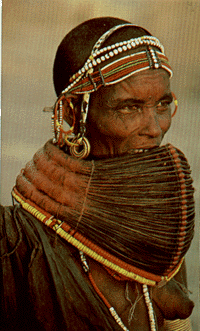
displays. In some African tribes, the appearance of a woman can directly indicate such
issues as marital status, age, background, and intent to marry. The picture located to the
left of this page demonstrates this (National
Geographic, 1984) . The woman's collar is an example of a Kenyan wedding collar. The
larger the collar, the higher the woman's status - and that of her husband. Articles of
clothing can also denote the
Research suggests that there is a
great deal of significance placed upon physical attractiveness. For example, there are
many attributions made about a person's status based upon
their level of attractiveness. Research by McArthur & Baron (1983) suggests that a
portion of the appeal of physically attractive features evolved from those features
serving as affordances or symbols of social fitness; a focus on outer beauty may have
stemmed from the need for desirable inner qualities. Eagly, Ashmore, Makhijani, &
Longo (1990) and Feingold (1992) demonstrated this by finding that physical beauty can
deceive the senses by appearing to offer more valuable qualities than are actually
delivered. This can be true cross-culturally
as well. In some cases, however, attributions are replaced somewhat by more intentional
displays. In some African tribes, the appearance of a woman can directly indicate such
issues as marital status, age, background, and intent to marry. The picture located to the
left of this page demonstrates this (National
Geographic, 1984) . The woman's collar is an example of a Kenyan wedding collar. The
larger the collar, the higher the woman's status - and that of her husband. Articles of
clothing can also denote the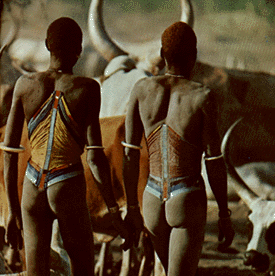 age of men in certain African
tribes. An example of this is shown in the picture to the lower right (National Geographic, 1984). The
colors of these men’s corsets vary according to the owner’s age group: red and
black for 15- to 25- year old; pink and purple between the ages of 25 and 30;
predominately yellow for those over 30.
age of men in certain African
tribes. An example of this is shown in the picture to the lower right (National Geographic, 1984). The
colors of these men’s corsets vary according to the owner’s age group: red and
black for 15- to 25- year old; pink and purple between the ages of 25 and 30;
predominately yellow for those over 30.
This contrasts somewhat with the American standard of hiding one’s true status in order to project a desired image - usually that of rich, young, and successful. Often in American culture, this desired image, one of extreme thinness for women, can lead to many problems. These problems include eating disorders among American women. American beauty standards seem to be driven by the attributions made about attractive people. Cunningham (1981,1986) as well as Cunningham, Barbee, & Pike (1990) describe the Multiple Fitness model of social perception which outlines the importance of the relationship between the target's face and body features; the perceiver's needs and characteristics; and the perceiver's evaluations of the target's attractiveness and implicit fitness for various biological, social, and personal challenges. The desire to be as physically appealing as possible pushes the fashion and health and beauty industry. The great divide between cultures is thus created.
Research suggests, however, that there might not be a great deal of variation as to what is attractive among some different cultural groups. A study by Cunningham, Roberts, Barbee, Druen, & Wu (1995) found that Asian, Hispanic, and White judges were strikingly consistent in their judgments of what was attractive: faces with neonate large eyes, greater distance between eyes, and small noses; sexually mature, narrower female faces with smaller chins; expressive, higher eyebrows, dilated pupils, larger lower lips, larger smiles and well-groomed, full hair. They also suggested that even with these similarities, the cultural reasons for these preferences may indeed vary dramatically. A follow up study determined that the degree of exposure to Western culture did not appear to influence ratings of attractiveness. Van den Berge and Frost (1986) even found that some African cultures that did not have a dominant White population preferred lighter skin for women. Throughout this research, the question still looms whether there is a Western standard of beauty that predominates throughout the world.
Back
To Psy 324 Home Page
Back to Psybersite
Please note: Original materials in these pages can be used for
research and education, but please credit the authors and the source. All
copyrighted materials are used here with permission and may not be reused without
contacting the copyright holder.