
Living in a Social World
Psy 324: Advanced Social Psychology
Spring, 2000
News from a Social Psychology Perspective
Should the Confederate Flag Continue to Fly Over the Capitol of South Carolina? Identityd and Intergroup Conflict -- January, 2000
Analysis
by
Megan Bitsoff, Ashley Dickirson,
Jennifer Scmit, & Brent Scott
South Carolina was the first state to secede
from the union in 1861. One hundred years later, the confederate battle flag was
positioned above the statehouse in recognition of the 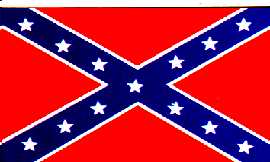 Civil War. South Carolina continues
to allow the flag to fly today, almost four decades later. This flying has caused the
state to become divided. This issue is representative of the discord between blacks and
whites. This results from the symbolism surrounding the flag. Supporters of the flag have
stated that the flag, "represents the courage, the valor and the sacrifice of South
Carolinians who answered the call of the elected government and died in service to the
state." In opposition, non-white residents of South Carolina feel that the flag is a
symbol of racism and oppression. They argue that this is much deeper than just a flag, and
suggest that the flag says, "this is a white supremacist statehouse."
Civil War. South Carolina continues
to allow the flag to fly today, almost four decades later. This flying has caused the
state to become divided. This issue is representative of the discord between blacks and
whites. This results from the symbolism surrounding the flag. Supporters of the flag have
stated that the flag, "represents the courage, the valor and the sacrifice of South
Carolinians who answered the call of the elected government and died in service to the
state." In opposition, non-white residents of South Carolina feel that the flag is a
symbol of racism and oppression. They argue that this is much deeper than just a flag, and
suggest that the flag says, "this is a white supremacist statehouse."
Last summer, the NAACP decided that this was no longer tolerable. They initiated an economic boycott of South Carolina, which has primarily effected tourism and conventions. The estimated cost of the boycott is seven million dollars. Ironically, the boycott has been most damaging to the blacks who hold the larger share of service sector jobs in South Carolina.
The legislature must approve the relocation of the flag. In 1994, the Senate passed a bill proposing to move it, which was then blocked by the House and has never been congressionally revisited. Currently, South Carolina's Chamber of Commerce is holding meeting to discuss alternative flags. After forty years, the state finally voted unanimously to end the flight of the confederate flag and agreed to raise a new and alternative memorial symbol.
In class we discussed reasons that people
may have for supporting the flag. We noted that prior to an editorial in a
South Carolina paper, there was never a large controversy over the flag. In order to
understand South Carolina’s point of view, one must take into consideration social
learning theory. This theory stresses that children as well as adults living in South
Carolina may possess a very different view than those in the rest of the United States due
to several reasons. For one, individuals in South Carolina learn from others that the
Confederate flag is acceptable. This is an environment where implicit attitudes about race
are being cultivated. Children in
schools may learn that the Confederate flag is a symbol of state pride, therefore
internalizing the notion that the Confederate flag should be viewed in a positive light.
On the flip side of the coin, those opposing the flag may have been taught the flag is a
symbol of racism. This problem closely resembles the recent debate over Miami’s
school name, which caused a great deal of controversy. Paralleled with the controversy
surrounding the Miami
nickname, we concluded that the length of time associated with something greatly
determines the amount of attachment we have to it.
that prior to an editorial in a
South Carolina paper, there was never a large controversy over the flag. In order to
understand South Carolina’s point of view, one must take into consideration social
learning theory. This theory stresses that children as well as adults living in South
Carolina may possess a very different view than those in the rest of the United States due
to several reasons. For one, individuals in South Carolina learn from others that the
Confederate flag is acceptable. This is an environment where implicit attitudes about race
are being cultivated. Children in
schools may learn that the Confederate flag is a symbol of state pride, therefore
internalizing the notion that the Confederate flag should be viewed in a positive light.
On the flip side of the coin, those opposing the flag may have been taught the flag is a
symbol of racism. This problem closely resembles the recent debate over Miami’s
school name, which caused a great deal of controversy. Paralleled with the controversy
surrounding the Miami
nickname, we concluded that the length of time associated with something greatly
determines the amount of attachment we have to it.
In addition to social learning theory, attribution theory also plays an important role. Those who are opposed to the Confederate flag are likely to attribute negative internal causes for the behavior of those living in South Carolina. Those in opposition may, for example, believe that individuals from South Carolina are racist or prejudiced. While this may be accurate for some, the opposed fail to realize external factors for behavior, such as the social learning theory. Therefore, social learning theory and attribution all play an important role in the attitudes and beliefs of those involved with the South Carolina controversy. We concluded this portion of the discussion by employing an analogy. South Carolina might not be such a bad ball player, they may be blinded by the sun.
Clearly, race plays a part in the Confederate flag issue. People outside of South Carolina have developed a schema where they believe South Carolinians are racist. Attention and memory allow this to happen. People only pay attention to and remember those who are racist and from South Carolina thus confirming their suspicions. The in-group and out-group bias is also involved in this. It can be looked at in two different ways. The first way is to view whites as part of the in-group. People in the in-group view the out-group as one or very similar to each other. In this sense, they see this as an issue of race or stereotyping. The other way to look at it is to look at blacks and whites as part of the in-group and everyone else as the out-group. This makes it look like an issue of race between the two ethnicities.
In addition, the class used their knowledge of groupthink as a way of explaining the opinions and actions of these two highly cohesive groups(the flag supporters and the flag opponents). Groupthink has often resulted in disastrous decisions including the the Challenger crash and Heaven's Gate. In class, we discussed some symptoms of groupthink including: failing to survey possible alternatives and objectives, failing to examine the major costs and risks of the preferred choice, and conducting a poor information search. While some people viewed the supporter's objective as an attempt to keep racism alive, others believed that it was a symbol of history and pride. The class suggested that those who supported the flag might not have examined the major risks of flying the flag above the state capital. Instead of uniting the state with the tradition of the flag, it divided the people into two opposing groups.
Back to Top
Back To Psy 324 Home Page
Back to Psybersite