
Living in a Social World
Psy 324: Advanced Social Psychology
Spring, 2000
News from a Social Psychology Perspective
Bridging The Gap of The Digital Divide: Modern Prejudice and Prosocial Behavior -- April, 2000.
Analysis by
Stephanie Allen, Adam Richardson, Lisa Russell, and Robert Woods
The social policy initiatives planned by President Clinton are intended to help those in need. When thinking about helping others, we can ask the question of why? What motivates us to help others, and what are the reasons our society is concerned with those less advantaged? C. Daniel Batson describes for psychological answers to the question of why we help others.
The first possible motivation is egoism. This is defined as helping another in order to benefit one's self. When applying this to the policy initiatives in this news article, we could postulate that the President decided to help others in order to create a more positive image for himself. In this way, the money being given to help the poor would just be for the purpose of ensuring others would think of President Clinton as a kind person who is interested in the needs of others. (Tesser, 347)
Another possible motivation is altruism. This is helping another as a means in itself. Altruism is unselfishly trying to help another simply because they are in need. From this perspective, we could interpret the policy initiatives as being designed and implemented in order to help others and with no other purpose. (Tesser, 354)
The third possible motivation for
helping is collectivism. This is defined as helping in order to benefit the group. By
helping the poor have 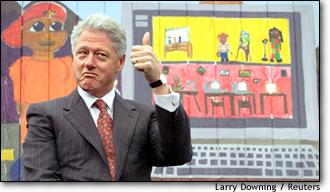 access to the
internet, we are creating a larger market for commercial sites. This may have positive
impacts on the economy and benefit all Americans. From this perspective, the President
would be concerned not just for the poor, but for all of society. (Tesser, 366)
access to the
internet, we are creating a larger market for commercial sites. This may have positive
impacts on the economy and benefit all Americans. From this perspective, the President
would be concerned not just for the poor, but for all of society. (Tesser, 366)
The last possible motivation for these policy initiatives is principlism. This is defined as benefiting another to uphold a moral principle. Applying this motivation we can see that the policies could have been designed simply because it is considered morally right to help those with less advantages. By giving the poor computer training and access to the internet we could be simply doing what we feel is right and just. (Tesser, 370)
It is conceivable that any of these psychological reasons for helping others could be society's and President Clintons' true motivation for assisting the poor. In our class discussion there was no agreement on which of these is most likely. It is quite possible that motivations for social policy initiatives are a combination of these four explanations.
In class we also discussed how Clinton's goals of spreading the technological wealth to those living in poverty as well as rural areas is demonstrative of the ideas of aversive racism. Oftentimes, politicians appear to support social programs for those at the low end of the socioeconomic ladder in order to adhere to the American ideals of equal opportunity for all.
However, merely throwing money toward programs such as these is only one small part of the large problem. As one student pointed out in class, how can someone take advantage of the internet if they do not even have a telephone? Furthermore, ultimate failure or limited success of these new programs will only serve to perpetuate the negative beliefs of modern racists who might claim the failure is a result of the poor's laziness or stupidity rather than place the blame on the government or perhaps society as a whole. Criticism of programs such as these, as well as affirmative action and welfare, is often rooted in blaming those who are intended to benefit instead of looking at the inadequacies of the programs themselves.
REFERENCES
Tesser, Abraham. (1995). Advanced Social Psychology. New York: McGraw-Hill.
Back to Top
Back To Psy 324 Home Page
Back to Psybersite