THE INTERNET GENDER GAP: IS IT NARROWING OR WIDENING?
Richard C. Sherman, Christian End, Egon Kraan,
Alison Cole, Jamonn Campbell, Zachary Birchmeier, & Charles Cohara
Department of Psychology
Miami University
Oxford, OH 45056
email: shermarc@miamioh.edu
Presented at the 107th Annual Convention of the
American Psychological Association
August 20th, 1999, Boston
Abstract
Two cohorts of students taking Introductory Psychology classes in 1997 and 1998 were compared in terms of their levels of participation in various internet activities and their attitudes about the technology. Results indicate that for certain activities, such as using the WWW, the internet gender gap is narrowing but it is still significant. For other activities the gap seems to be remaining the same or even reversing in direction. The data also indicate that men and women are becoming more similar in self-perceptions of familiarity with computer technology, yet their attitudes toward the technology do not seem to be converging.
Introduction
The internet has been a male domain since its beginnings in the 1970's (King, Grinter, & Pickering, 1997; Morahan-Martin, 1998; Rheingold, 1993). A number of studies have indicated that the gender gap in internet use has narrowed in recent years but has not closed entirely. For example, surveys of World Wide Web (WWW) users conducted by the Graphic Visualization and Usability Center (GVUC) at Georgia Tech University showed dramatic yearly increases in the number of women users from 6% in 1994 to 39% in 1997 (GVUC 1994, 1997). In 1998, however, the percentage of women users was unchanged, again 39%.
Differences between women and men's responses to technology might be particularly important in higher education, where internet activities are increasingly a central feature of the curriculum in a variety of departments, including programs that are elected by large numbers of women, such as psychology and sociology (Sherman, 1998; Sherman, End, Kraan, Martin, Cole, & Gardner, 1998). Understanding how college men and women approach the pedagogical use of internet technology may increase its educational effectiveness.
The purpose of the present study was to examine gender differences in internet use in a university population and to investigate attitudinal correlates of internet experience. Two cohorts of students taking Introductory Psychology classes in 1997 and 1998 were compared in terms of their levels of participation in various internet activities and their attitudes about the technology. We were particularly interested in the nature and size of any behavioral and attitudinal differences between men and whether these patterns demonstrated significant shifts over time.
Method
Six hundred thirty-six participants (442 women and 194 men) completed a computer survey in return for research experience credit in introductory psychology courses. One cohort of participants took the survey during the fall semester 1997 (275 women and 115 men) and a second cohort took it during the fall semester of 1998 (167 women and 79 men). The survey assessed levels of participation in various internet activities, self-perceptions of familiarity with computers, and attitudes towards computer use. Separate attitude questions focused on: (1) personal experience using computers; (2) computers in college courses; (3) impact of computers on society and culture. The survey was included in a packet of unrelated materials as part of a department-wide mass testing during each semester.Results
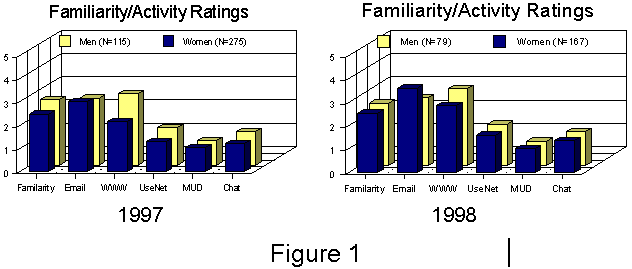
Men reported significantly (p < .01) higher levels of participation than women did in three of five internet activities: WWW, Newsgroups, and Chat Groups (see Figure 1). Women reported significantly higher Email use than did men, F(1, 634) = 8.95, p < .01. Men and women did not differ significantly in their reports of participation in Multi-User Dungeons (MUD=s), F's < 1. Cohort differences were significant for three internet activities, and in all three the level of use reported by the 1998 cohort was greater than the 1997 cohort: WWW, F(1, 634) = 15.58, p < .01; Email, F(1, 634) = 4.93, p < .05; Newsgroups, F(1, 634) = 9.53, p < .01.
An important aspect of the data is whether the sizes of gender differences are different for the 1997 versus 1998 cohorts. For two activities Gender interacted significantly with Cohort: Email use, F(1, 634) = 3.98, p < .05, and WWW, F(1, 634) = 4.17, p < .05. An examination of the pattern for Email use showed that whereas men and women did not differ in the 1997 cohort, F < 1, women reported significantly higher levels of use than men did in the 1998 cohort, F(1, 245) = 10.76, p < .01. For WWW use the data indicate a smaller difference between men and women in the 1998 than 1997 cohorts, but men reported significantly higher activity than women did in both the 1997, F(1, 634) = 8.95, p < .01 and 1998 cohorts, F(1, 246) = 5.32, p < .05. Overall these data suggest that there is some reduction in the internet gender gap, but important differences remain in certain internet activities.
Women rated themselves as significantly less familiar with computers than did men, F(1, 634) = 8.52, p < .01 (see Figure 1). However, there was a tendency for this difference to be greater in the 1997 than 1998 cohort, as revealed by the Gender x Cohort interaction, F(1, 634) = 3.53, p < .06. Separate analyses for each cohort indicated that men in the 1997 cohort reported significantly greater familiarity than women did, but this comparison was not significant for the 1998 cohort.
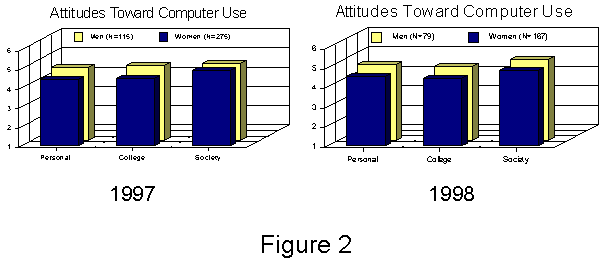
Men expressed significantly more positive attitudes than women about their own personal experiences with computers, F (1, 634) = 9.85, p < .01, and about the use of computers in college classes, F(1, 630) = 10.57, p < .01 (see Figure 2), and these gender differences were similar for both cohorts. Attitudes about the role of computers in society, however, displayed different patterns in the 1997 and 1998 groups; Gender x Cohort interaction, F (1, 634) = 4.49, p < .05. Men and women in the 1997 cohort did not differ significantly in their attitudes, F<1, whereas in the 1998 cohort men were significantly more positive than women were, F (1, 244) = 5.63, p < .05. In summary, gender differences in attitudes about computers were either constant across cohort or were greater in the 1998 cohort.
Conclusions
Our data suggest that for certain activities, such as using the WWW, the internet gender gap may be narrowing but it is still significant, a finding consistent with other research (e.g., GVUC, 1998). For other activities (e.g. Newsgroups, Chat), however, the gap seems to be remaining the same or even reversing in direction (e.g., Email).
Our data also indicate that men and women are becoming more similar in self-perceptions of familiarity with computer technology, yet their attitudes toward the technology do not seem to be converging. Men were more positive than women regarding their personal experiences with computers in both our 1997 and 1998 cohorts. Our results indicate that a gender gap also exists in men's and women's attitudes about their experiences with computer technology in the college curriculum. This finding is important because it suggests that gender differences in the way men and women evaluate their educational outcomes may be based in part on their responses to use of computer technology in the classroom. Finally, our results indicate that men and women differ in their evaluation of the impact of computer technology on society more generally, with men being more positive in their assessment. Importantly, this gender gap is larger in our 1998 group.
References
Graphics, Visualization and Usability Center (GVUC). (1994). GVU's 1st WWW User Surveys. Atlanta, GA: Georgia Tech Research Corporation. (Available: http://www.gvu.gatech.edu/user_surveys/survey-01-1994/ ).
Graphics, Visualization and Usability Center (GVUC). (1997). GVU's 8th WWW User Surveys. Atlanta, GA: Georgia Tech Research Corporation. (Available: http://www.gvu.gatech.edu/user_surveys/survey-1997-10/ ).
Graphics, Visualization and Usability Center (GVUC). (1998). GVU's 9th WWW User Surveys. Atlanta, GA: Georgia Tech Research Corporation. (Available: http://www.gvu.gatech.edu/user_surveys/survey-1998-04/ ).
King, J.L., Grinter, R.E., & Pickering, J.M.. (1997). The rise and fall of netville: The saga of a cyberspace construction boomtown in the great divide. In S. Kiesler (Ed.), Culture of the Internet (pp. 3-33). Mahwah, NJ: Lawrence Earlbaum Associates.
Morahan-Martin, J. (1998). Males, females, and the internet. In J. Gackenbach (Ed.), Psychology and the Internet (pp. 169-197). San Diego, Academic Press.
Rheingold, H. (1993). The virtual community: Homesteading on the electronic frontier. New York: Addison-Wesley.
Sherman, R.C. (1998). Using the world wide web to teach applications of social psychology to everyday life. Teaching of Psychology, 25, 212-216.
Sherman, R.C., End C., Kraan E., Martin, J. Cole, A., & Gardner, J. (1998). Sex Differences in Internet Use: Attitudinal and Experiential Correlates. Presented to the American Psychological Society Convention, Washington, May, 1998.