SEX DIFFERENCES IN INTERNET USE: ATTITUDINAL AND
EXPERIENTIAL CORRELATES
Richard C. Sherman, Christian End, Egon Kraan,
Julie Martin, Alison Cole, & Jeff Gardner
Miami University
shermarc@miamioh.edu
American Psychological Society Convention
May 23, 1998, Washington, D.C..
Introduction
A number of past studies have documented sizeable differences
between women and men in their levels of participation in internet technology. For
example, in a recent survey of approximately 10,000 World Wide Web (WWW) users conducted
by the Graphic Visualization and Usability Center (GVUC) at Georgia Tech University
(1997), the percentage of men (61%) far exceeded the percentage of women (39%). This
difference has been observed in all eight of the Georgia Tech surveys conducted since
January, 1994.
One arena in which such differences might have important
implications is in higher education, where internet technology is increasingly a central
feature of the curriculum in a variety of departments. The purpose of the present study
was to examine patterns of internet use in a college population, and to focus specifically
on attitudinal correlates of internet experience.
Method
Three hundred ninety participants (115 men and 275 women) completed
a computer survey in return for research experience credit in introductory psychology
courses. The survey assessed levels of participation in various internet activities,
self-perceptions of familiarity with computers, and attitudes towards computer use.
Separate attitude questions focused on: (1) personal experience using computers; (2)
computers in college courses; (3) impact of computers on society and culture. The survey
was included in a packet of unrelated materials as part of a department-wide mass testing
program conducted during the Fall, 1997 and Spring, 1998 semesters.
Results
Men reported significantly (p < .01) higher levels of
participation than women in three of five internet activities: WWW, Newsgroups, and Chat
Groups (see Figure 1). Men and women did not differ significantly in their reports of
email use or participation in Multi-User Dungeons (MUD’s), F’s < 1.
With these two exceptions, the data for our college student sample shows a pattern of sex
differences similar to that found in GVUC studies of the general population.
Women rated themselves as significantly less familiar with computers
than did men, F(1, 383) = 13.50, p < .01 (see Figure 1.). This
difference was not accounted for simply 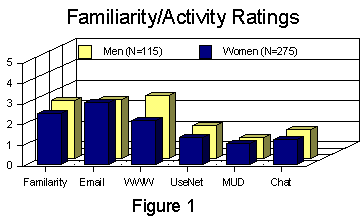 by differential levels of
experience, however. Analyses of covariance using each of the activities as a covariate
showed that differences in familiarity remained significant in all cases except when level
of WWW use was the covariate. Differences also remained significant when the number of
courses students had taken that made use of the internet was controlled, F (1, 387)
= 12.16, p < .01.
by differential levels of
experience, however. Analyses of covariance using each of the activities as a covariate
showed that differences in familiarity remained significant in all cases except when level
of WWW use was the covariate. Differences also remained significant when the number of
courses students had taken that made use of the internet was controlled, F (1, 387)
= 12.16, p < .01.
Although men and women reported similar attitudes
toward the impact of computers on society, men were significantly more positive about
their own personal experiences 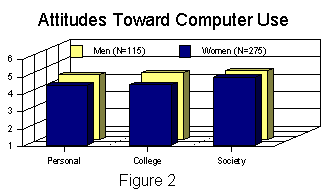 with computers, F (1, 383) = 6.11, p < .05, and
about the use of computers in college classes, F(1, 380) = 4.84, p <
.01 (see Figure 2). Controlling for levels of participation in internet activities using
analyses of covariance eliminated these differences, but controlling the number of
internet-involving courses did not.
with computers, F (1, 383) = 6.11, p < .05, and
about the use of computers in college classes, F(1, 380) = 4.84, p <
.01 (see Figure 2). Controlling for levels of participation in internet activities using
analyses of covariance eliminated these differences, but controlling the number of
internet-involving courses did not.
Conclusions
College men and women in our study differed in their levels of
participation in internet activities, their self-perceptions of familiarity with
computers, their attitudes toward personal experiences with computers, and their attitudes
regarding the role of computers in higher education. Attitudinal and familiarity
differences remained even after controlling for the number of courses students had taken
that required internet activities. This suggests that men and women may experience such
courses differently, an implication that should be carefully explored.
When men and women were statistically equated in terms of voluntary
activities (MUD, USENET, WWW, Chat, Email) their attitudinal differences were eliminated
but their self-perceptions of familiarity were not. The latter finding may reflect a
cultural stereotype of computer expertise as a male-specific quality. That is, in judging
their level of familiarity with computers, both men and women may implicitly use a male
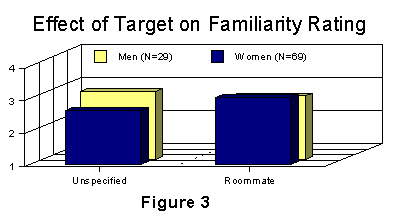
comparison target. To explore this possibility, a question was added to the second
semester questionnaires that asked respondents to compare their level of familiarity to
their same-sex roommate. As shown in Figure 3, men and women did not differ when the
reference target was specified, thus supporting the stereotype possibility.
Send for Reprint
Back to Top
Back to Homepage