 |
 |
 |
 |
Richard C. Sherman, Christian End, Egon Kraan,
Alison Cole, Julie Martin, & Jaime Klausner
Miami University
shermarc@miamioh.edu
American Psychological Society Convention
June 4, 1999, Denver, Colorado
Introduction
In this study we were interested in the qualities of impressions generated from WWW home pages. Are web-based impressions more extremely positive or negative than those formed in face-to-face situations? Are web-based impressions more positive or more negative than intended by the creators of home pages?
There are two lines of thought that might form the basis for predicting the answers to these questions. The first stems from what is often called the "cues - filtered-out" hypothesis of computer mediated communication (Keisler, Siegel, & McGuire, 1984) -- the idea that the computer medium reduces information about another person's motives, goals, and personality and therefore makes it difficult to form an accurate impression of the other person. It follows that people would be rather uncertain of their online impressions of others and this would prevent them from perceiving other people in a strongly positive or negative light.
A second line of thought is based on the "hyperpersonal" model of computer-mediated communication (Walther, 1996). The model proposes that the electronic medium allows greater control of the impression one gives to other people than is ordinarily possible in face-to-face interaction. Information content and presentation style can be manipulated more easily to create a particular self-portrayal -- usually one that is intended to be socially desirable. Thus, we may be able to create more positive impressions online than in face-to-face situations. Futhermore, because situational cues are greatly reduced online, perceivers are even more apt to attribute internal dispositions than in face-to-face contexts, and thus they may be more confident of the impressions they form.
Method
We selected a random sample of 86 home pages from prominent WWW sources. Thirty undergraduate volunteers (15 women & 15 men) viewed subsets of these pages and rated their impressions of the people who had created them. For comparison purposes, these participants also rated two people they knew from face-to-face interactions: someone they knew well and were very familiar with, and someone they knew as a casual acquaintance.
We contacted the creators of the home pages and asked them to complete measures of what they thought their pages conveyed. Twenty responded and completed one or more of the questionnaires. We compared the impressions that these creators of home pages thought they were giving to the impressions reported by participants who had viewed those home pages.
Results
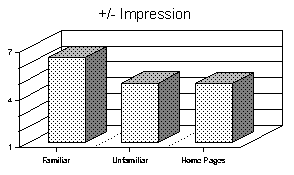
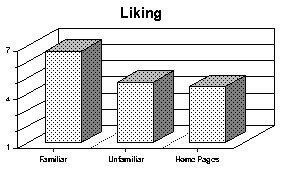
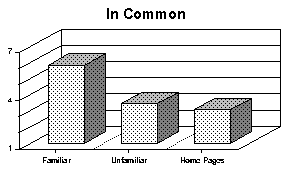
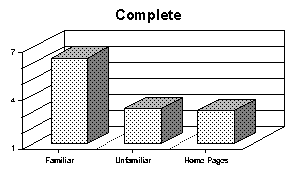
The overall pattern of results falls somewhere between the predictions of the cues-filtered-out and hyperpersonal models described above. As shown in the graphs below, perceivers were generally not as
|
|
|
|
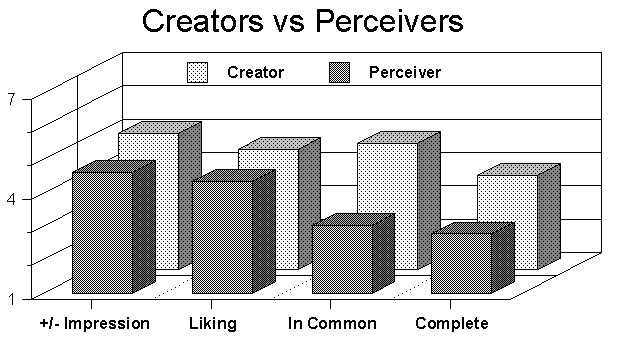
We compared the impression ratings of the each of the 20 creators who responded to our request to the ratings of the people who had judged those particular pages. As shown in the graph below, a very clear trend emerged in these data -- creators believed that others would be more positive and confident in their assessments than the perceivers actually were. The largest discrepancies were on items assessing how much in common the perceiver would think he/she had with the creator, t (18) = 3.79, p < .001, and how complete the impression was, t (18) = 2.49, p <.05.
Conclusions
Our results do not support the idea that the WWW medium is so impoverished that people will be more neutral in their impressions formed from home pages than from face-to-face interaction. However, neither is there evidence that the heightened impression management capabilities of the web lead to exceedingly positive impressions.
The finding that home page creators erred in the positive direction in estimating how others might respond to their home pages is certainly interesting, and may be similar to the tendency in face-to-face interactions to assume that others like us and that they think like we do. It is not clear from our data, of course, whether this error is greater in web-based impressions than it is in face-to-face impressions. We are currently conducting additional research to answer this question.