The Internet Gender Gap Among College Students
Christian End, Egon Kraan, Alison Cole, Jamonn
Campbell, Zachary
Birchmeier, Jaime Klausner, & Richard C. Sherman
Miami University
Presented to MPA, Chicago, May 2000
Abstract
This longitudinal study examined gender differences in Internet use and investigated attitudinal correlates of Internet experience over a year's time. The results suggest that the Internet gender gap may be narrowing but is still significant. Implications are discussed for higher education, where the curriculum necessitates the use of computers.
Introduction
The Internet has been male dominated since its inception (Gackenbach & Ellerman, 1998). Recent research suggests that the gender gap in using certain Internet components, such as the World Wide Web (WWW), has narrowed but has not closed entirely (GVUC, 1994, 1998; Sherman, End, Kraan, Cole, Campbell, Birchmeier, & Cohara, 1999). However, nearly all studies has been cross-sectional in nature, relying on comparisons between men and women in cohorts of different ages. Thus, the extent to which individual men and women change over time in their internet behaviors and attitudes is not clear.
One area in which longitudinal differences in individual responses to technology might be increasingly important is in higher education, where Internet activities are becoming a central feature of the curriculum. Understanding how men and women experience a computer-centered curriculum over time would be helpful in developing effective pedagogical techniques.
The purpose of the present longitudinal study was to examine collegiate gender differences in Internet use and to investigate attitudinal correlates of Internet experience over a year's time.
Procedure
One hundred fifty-five undergraduate students who completed a computer usage survey in the Spring of 1997 were contacted a year later to retake the same survey. Ninety_nine (74 females, 25 males) agreed to participate. The computer survey assessed demographic characteristics, participation in Internet activities (WWW, e_mail, Newsgroups, chat, MUD), and student's attitudes towards computers (personal, general role in college, and impact of computers in society).
Results
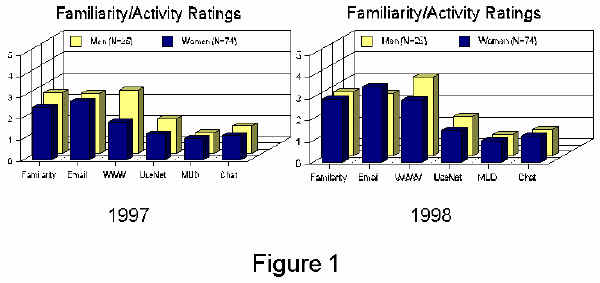
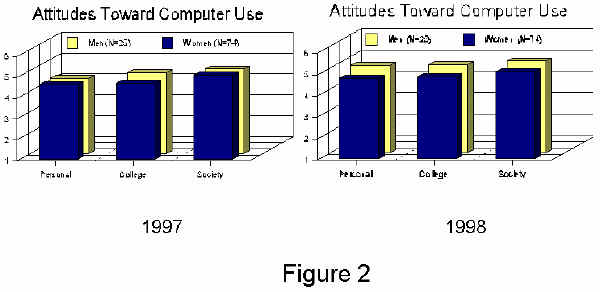
The survey data are presented in Figure 1 (Familarity/Activity Ratngs) and Figure 2 (Attitude Ratings). The data were analyzed in a 2 x 2 ANOVA: Time of Observation (1997 versus 1998) by Sex (Male versus Female). In general, from 1997 to 1998 students significantly (p<.05) increased on three of the five activity measures: WWW, e_mail, and Usenet. On all three attitude measures students became more positive, although only the change in personal attitudes reached significance (p<.05). Students also significantly increased in their self-perceptions of familiarity with the technology.
Men reported overall higher levels of participation than women in two activities: WWW and Usenet. The Time by Sex interactions were not significant for either measure, indicating that these gender differences did not diminish over time. There was also a significant Time by Sex interaction for e-mailing (p<.05). Females’ e-mail usage significantly increased from 1997 to 1998 while males’ usage did not change, and in 1998 female’s usage was higher than men’s (p <.06). The Time by Sex interaction was also significant for self perceptions of familiarity with computer technology: Women’s perceptions became more positive (p<.05), whereas men’s perceptions did not change significantly.
As can be seen in Figure 2, men were consistently more positive than women on all three attitude items in both 1997 and 1998. Our statistical tests of these differences did not reach significance, however, nor did any of the Time by Sex interactions. We suspect this may be due to sampling and/or power problems, since the sex differences on two of the three attitude items (personal experience and use in college courses) were significant for the entire 1997 pool from which the longitudinal sample was drawn.
Conclusions and Implications
Our data indicate that college men and women differ in the levels and patterns of their internet usage, and that these differences are not reduced by students’ experiences with the technology over a years’ time. Thus, our study suggests that in higher education, where the curriculum is beginning to necessitate the use of computers and the Internet, the experiential gap between males and females does not appear to be reduced by the current ways that technology is incorporated into courses. The pedagogical implications of men’s and women’s different responses to computer technology should be explored more thoroughly.
Send for Reprint (include name of paper and your mailing address)