On-line Versus Real World Impressions
Christian End, Egon Kraan, Alison Cole, Jamie
Klausner
Zachary Birchmeier, Jamonn Campbell & Richard C. Sherman
Miami University
Presented to MPA, Chicago, May 2000
Abstract
Impression meta-accuracy was assessed in WWW homepages and face-to-face dyadic interactions. Self-ratings were stable across context whereas perceivers’ impressions were less positive in the web context. Reduced levels of interactivity and social and contextual cues in WWW homepages were found to negatively affect the actual impressions formed by perceivers.
Introduction
The intent of this study was to compare impression meta-accuracy of WWW homepage creators to meta-accuracy of people in face-to-face interactions. Computer-mediated impressions are made in environments lacking many social and context cues that influence impressions in a face-to-face setting, including body language and speaking qualities (Sproull & Kiesler, 1986). Because creators of WWW pages have absolute control of the information that is made available, this may lead them to believe that the impressions they create online and face-to-face are similar. Perceivers, on the other hand, may actually form discrepant impressions based on the amount of available social and context cues.
Procedure
In the Online Condition 120 undergraduates viewed subsets of 3 to 4 WWW homepages drawn from a pool of 40 pages and recorded their impression of the creator of each page. In the Face-to-Face Condition 58 participants interacted in 10-minute dyadic sessions with several different partners. In both conditions the targets of the impressions indicated their meta-perceptions (how they thought others viewed them) on the same scales used by the perceivers.
Results
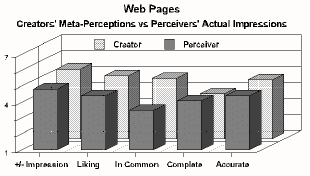
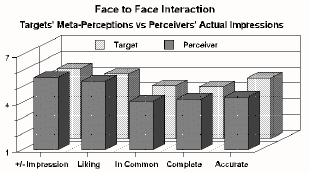
The data were analyzed using a 2(Source: Self v. Perceiver ratings) X 2(Context: WWW v. FTF) mixed model ANOVA with source as a repeated measure. There was a general tendency for Targets to believe they
were perceived more positively than they actually were (cf. Figure 1). This tendency was greater in the Online Condition, as indicated by significant interactions (p < .05) for the positivity/negativity of the impression item, the likeability item, and the commonality item. There was also a tendency for Perceivers’ impressions to be more influenced by Context (Web Page vs Face-to-Face) than Targets believed them to be. Analyses of the context simple effects on positivity/negativity, likeability, and commonality were significant for Perceivers’ Impressions but not for Targets’ meta-perceptions.
Conclusions and Implications
Our results suggest that, perhaps because of the perceived control of information that can be placed on one’s personal homepage, page creators may believe that the impression they convey to others is parallel to that conveyed through face-to-face interaction. However, the reduced levels of interactivity as well as social and contextual cues in WWW homepages negatively affects the actual impressions formed by perceivers. While there is an increasing interest in publishing homepages on the WWW, creators should be aware that their control of page content does not necessarily foster well-developed impressions.