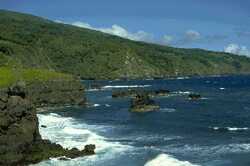
Photo Courtesy of Microblast
Ecology
Chad Crandell, Julie Curtis
Shannon Ingalls, and Mike Kurka
Please Note: These materials may be used for research, study, and education, but please credit the authors and source.
Photo Courtesy of Microblast
Hawaii’s native plants, animals, and ecosystems are a unique legacy in danger. About 90% of Hawaii’s native plants and animals occur nowhere else in the world and nearly 1,000 different kinds of Hawaiian plants and animals are threatened by extinction. Although Hawaii occupies only .2% of the land in the United States, nearly 75% of the nation’s documented plant and bird extinction’s are from Hawaii. Loss of species is an indicator that points to the deterioration of an ecosystem- ecosystems that human beings need to survive. Unfortunately, there are many threats to Hawaii’s native ecosystems and unique plants and animals. These threats include the development of various kinds (e.g., agricultural, housing, recreation, industry), which are likely to further change the ecology of the island.
Hawaii has rich agricultural resources which have many different contributions. Our agricultural industry depends on Hawaii’s climate and water supply, and therefore, depends on healthy forest watersheds. Many of the watersheds in Hawaii are not in good condition because they exceed their sustainable yield, which has detrimental effects on our agricultural industry. If there is further development in Hawaii, more people are going to either move or visit the area, which would make the depleted aquifer situation even worse. Hawaiian species have also contributed to the genetic improvement of major agricultural crops. For example, a native Hawaiian cotton is being used by American cotton breeders to produce new strains less vulnerable to insect pests. If there is further development in the area, these important species may become endangered or extinct because of the building of new structures or the presence of more people.
The number of hotels in Hawaii has increased drastically within the last five to ten years, particularly in North Beach. The existence of these hotels disturbs the natural environment of the area. They attract more people, which can lead to the destruction of wildlife and can also cause more pollution. There are many qualities of North Beach which need to be preserved rather than used. For example, it offers beautiful open space, it has a drainage basin and wetlands which sustain wildlife, and it offers respite to its visitors and residents. All of these qualities could be jeopardized if there was further development of hotels in the area.
Hawaii’s economy depends on its
environment, since tourism
is its number one industry. Hawaii
has lush green forests, beautiful coral reefs, and crystal clear water which provide
scenic value beyond words. Hawaii’s unique native flora and fauna contribute
enormously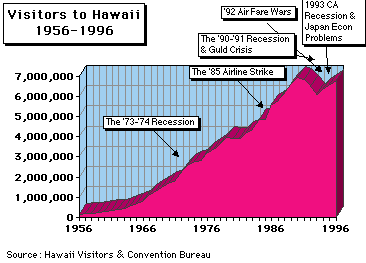 to our climate and outdoor lifestyle. Tourism in Hawaii has almost tripled
in the last five to ten years. This increase in tourism may bring in more money, but it
can also bring devastating consequences. The more tourists there are, the more the native
wildlife suffers. If the wildlife becomes endangered or destroyed, then the tourists will
not be interested in coming to Hawaii anymore. Not only will the tourism not help the
economy anymore, it will have destroyed much of the natural habitats in Hawaii.
to our climate and outdoor lifestyle. Tourism in Hawaii has almost tripled
in the last five to ten years. This increase in tourism may bring in more money, but it
can also bring devastating consequences. The more tourists there are, the more the native
wildlife suffers. If the wildlife becomes endangered or destroyed, then the tourists will
not be interested in coming to Hawaii anymore. Not only will the tourism not help the
economy anymore, it will have destroyed much of the natural habitats in Hawaii.
As stated before, many of the native wildlife in Hawaii is threatened or has already been destroyed. The original Hawaiians cleared lowland forests to cultivate the plants they brought with them- bananas, sugarcane. They also brought small pigs, which led to the extinction of at least 35 species of birds. One example of an endangered specie in Hawaii is the Maui Parrotbill. Its threats are the disturbance of native undergrowth by feral pigs, and by avian diseases, such as malaria, spread by introduced mosquitoes. The situation got worse when word of Captain James Cook’s discovery spread throughout the West. Over the next several decades outsiders introduced cattle, goats, and sheep. The Europeans and those who came after, changed the islands more in 200 years than the Polynesians had in 1,400. By 1900, the demand for wood and pastureland had depleted much of the rich green forests. Government agencies reforested hillsides with alien trees like eucalyptus and pine in the early 1900’s. Also, in the following decades developers poured concrete over beaches and drained wetlands. Avian diseases along with the competition from newcomers, predation, and habitat loss have contributed to the extinction of 27 species of birds since the arrival of Captain Cook.
We also rely on Hawaii’s environment for medicines. We depend on native plants and animals for 75% of all the medicines and pharmaceutical products we use. Scientists recently discovered a powerful anti-tumor compound in a soft coral , limu make or Hana, found only in a few spots on Hawaiian reefs. If there is further development, this coral could be destroyed and since there are only a few spots on the reefs, this medicinal could be lost forever. Without protection of our natural lands and biodiversity, we may never know the value of what we are losing.
Lastly, Hawaii has many watersheds which produce fresh water daily and it is a necessity for many people. Forest water sheds supply us with almost all of the fresh water we need. Healthy forests act like sponges that intercept rainfall and allow it to slowly percolate into groundwater aquifers and streams- bringing us water to our homes and businesses and irrigating our farms to grow the crops we eat. If there is further development, there will be more people, which could cause the aquifers to exceed their sustainable yield. If they sustain their yields, many people would be deprived of the freshwater they receive daily from that aquifer.
As you can see, Hawaii’s ecosystem is very unique and needs to be preserved. There are many advantages of Hawaii’s environments in which everyone benefits. Everyone in one way or another needs Hawaii’s ecosystem. If there were further development in Hawaii, its ecology could be destroyed forever, which could result in devastating consequences. We need to stop this development and save an environment that everyone relies on and needs in our daily lives.
Back to Top
Back To Psy 412 Home Page
Psy 412 Miami University. Last revised: . This document has been accessed times since July 15, 1997. Comments & Questions to R. Sherman . Also See: Social Psychology at Miami University