Social Issues and Psychology:
Psychology & The Environment
Fall, 1997
Values as Sources of Economic and Cultural
Conflict:
Recommendations for Possible Solutions
Jim Berling, Mary Krebsbach & Mike Kurka
Please Note: These materials may be used for research, study, and
education, but please credit the authors and source.
The Commons
Upstream Superiority
A Swedish Approach
The Commons
 The tragedy of the commons has been defined as "the consumption of a natural resource
by each of many individuals who have unrestricted access to the resource inevitably leads
to the resource's destruction" (Gardner and Stern, 1996, p. 23). In the case of Maui
and its potential development the resource in question is most visibly land. Although with
an increase in tourism water and other resources may be
under attack as well. More visitors may mean that there are more available opportunities
for people to neglect or abuse the environment. Right now the fear of some residents seems
to be that this new development will decrease the already scarce beach area further. As
already pointed out, West Maui has one of the last sandy beaches left on Maui and to
eliminate this resource further would be a great loss. [photo from hypertext guide to
Hawaii by J. Bisignani]
The tragedy of the commons has been defined as "the consumption of a natural resource
by each of many individuals who have unrestricted access to the resource inevitably leads
to the resource's destruction" (Gardner and Stern, 1996, p. 23). In the case of Maui
and its potential development the resource in question is most visibly land. Although with
an increase in tourism water and other resources may be
under attack as well. More visitors may mean that there are more available opportunities
for people to neglect or abuse the environment. Right now the fear of some residents seems
to be that this new development will decrease the already scarce beach area further. As
already pointed out, West Maui has one of the last sandy beaches left on Maui and to
eliminate this resource further would be a great loss. [photo from hypertext guide to
Hawaii by J. Bisignani]
William Ophuls has proposed four solutions for environmental
problems associated with the tragedy
of the commons. The first is governmental laws, regulations and incentives, which
would mean control by the state concerning environmental issues. The second is education
as a means of getting everyone to understand the problems and what they themselves can do
to help. The third is small group or community management by which groups within a larger
population come together to try to do what they can to combat the problem. And finally,
there are moral, religious and/or ethical appeals, which focus on incorporating people's
sense of values or beliefs to entice them into helping the environment.
Of all the four solutions Ophuls proposes community management
seems to be the most appropriate for the situation Hawaii is facing, although they all
could be incorporated. For example, it is important for all residents to be aware of the
problem, how it is going to effect them and what they can do about it. Similarly, there
may be moral, ethical and religious appeals that can be made for the new development on
Maui. In fact, the Native Hawaiians have seemed to use this tactic in order to mobilize
themselves against further development. They speak strongly about their culture's belief
of ecocentrism. Additionally, the state itself could step in to regulate how much of the
beach can be used for developmental purposes.
Community management is different in that it brings together
groups of citizens to combat the problem themselves. There is no governmental involvement.
The citizens form groups because they are concerned about their community. They all agree
upon the tactics they will undertake and follow the guidelines because they feel a
responsibility to each other and their community as a whole. They may even try to
incorporate some of the other solutions, such as education and moral, religious or ethical
appeals. A nice example of community management in Hawaii is the Native Hawaiians. This
group of people has come together because of their concern for their homeland and its
environment. They feel as though businesses and development are endangering places of
cultural and historical significance as well as the beaches and oceans. They do not want
development to compromise the beauty and culture of the Hawaiian people. As a community
they have 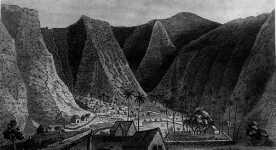 banded
together in large numbers. They have held meetings, rallies and even developed their own web page. [photo
from hypertext
guide to Hawaii by J. Bisignani]
banded
together in large numbers. They have held meetings, rallies and even developed their own web page. [photo
from hypertext
guide to Hawaii by J. Bisignani]
In the case of the developmental conflict between the economy and
the proponents of cultural significance we propose there needs to be some type of
compromise or discussion between the two sides. Both have very valid reasons for opposing
or supporting further development on West Maui. On one hand, there are sites of cultural,
historical and environmental significance that need to be protected and maintained. These
places have existed long before the United States
took over Hawaii in 1859 and should remain long after. On the other hand, Maui's
economy and many of its residents' jobs are dependent on the tourist industry. Without it
they may be forced to find other means of supporting themselves. Both sides have important
needs and concerns that need to be heard. Additionally, we must consider that each side is
not completely opposite of the other. For example, Native Hawaiians may be employed in the
tourist industry and thus would also be affected by a further decline in the economy. On
the other hand, the loss of culturally significant sites is a loss for the state of Hawaii
and its people, not necessarily just the Native Hawaiians. Hopefully by coming together
and talking about possible solutions these two sides can arrive at a plan which best
benefit's Maui and its citizens. We suggest that a combination of all four of these
solutions and others are needed in order to arrive at a workable solution.
Upstream Superiority
In order to promote a future for Hawaii to improve its economy
while preserving the environment, both sides must consider the possible effects of any
action or lack thereof. The use of upstream solution strategies could help both sides
become aware of the possible consequences or effects on Hawaii. As Gardner and Stern point
out, "technical analysis of many environmental problems reveal that upstream
intervention strategies are usually superior to downstream strategies" (Gardner &
Stern, 1996, p. 267-268).
 By taking a proactive stance on further land development, developers can become aware of
not only the environmental effects in the short term, but also what the fallout from those
effects may be in the long term. For example, rather than curtailing activities which harm
the environment immediately, such as deforestation, resort owners need to consider what
major fundamental changes could occur, such as extinction of major species
vital to the island. This thinking needs to proceed even further. Future economic
difficulties will result if some or all of Hawaii's ability to be self-sufficient is
disabled by resort expansion. What steps will or can be taken at that point to promote
further economic stability? [photo from hypertext guide to
Hawaii by J. Bisignani]
By taking a proactive stance on further land development, developers can become aware of
not only the environmental effects in the short term, but also what the fallout from those
effects may be in the long term. For example, rather than curtailing activities which harm
the environment immediately, such as deforestation, resort owners need to consider what
major fundamental changes could occur, such as extinction of major species
vital to the island. This thinking needs to proceed even further. Future economic
difficulties will result if some or all of Hawaii's ability to be self-sufficient is
disabled by resort expansion. What steps will or can be taken at that point to promote
further economic stability? [photo from hypertext guide to
Hawaii by J. Bisignani]
It is equally important that Native Hawaiians and other
ecocentric interest groups subscribe to this line of thinking. As the economy continues to
fail, more jobs will be lost and the standard of living will suffer. While it is necessary
to protect the environment, it is nearly impossible to bolster the economy with no
negative effects as a result. If a society begins to hurt economically, other negative
social factors will often result, the likes of the Great
Depression on a smaller scale and inevitably culturally decay. In order to halt
this downward trend, it is necessary to think of ways to preserve both the environment and
culture. There are some encouraging strides being made. According to Martin Kasindorf, new
industries, such as macadamia
nuts and Kona coffee, are
beginning to flourish (1997). Perhaps the success of these ventures will promote the idea
that Hawaii can depend on its environment to be self-sufficient and profitable as well.
We believe that it is necessary to adapt upstream solution
strategies to most effectively solve Hawaii's current cultural, environmental and economic
dilemmas. All people, regardless of value orientation, must strive to see things from a
variety of perspectives and reach feasible solutions to protect Hawaii's assets, both
economical and environmental.
A Swedish Approach
As the economic situation in Hawaii continues to decline, efforts
toward the introduction of new industries are being sought, such as in telecommunication and oceanography,
to help cushion its devastating blow (Kasindorf, 1997). Although these new potential
profit-making sources may have some impact in the future, as Martin Kasindorf states,
"[i]t's hard to see a new boom resulting from anything but rejuvenated tourism"
(Kasindorf, 1997, p. A18). If this in fact is the case facing Hawaii and its economic
decline, then seemingly any plausible resolution to the problem must involve tourism in
some way. Hotel and tourist resort production is definitely one way to bring in more
tourists and makes development appear to be an only option or does it?
The creation of new structures to attract tourism looks to be an
effective way of solving the distress caused by Hawaii's failing economy until you take
into account the potential effects on cultural significance, not to mention the cost of
their construction. A solution to the developmental problems facing North Beach and other
areas must incorporate these oppositions. This is where we suggest a somewhat new approach
to solving environmental problems, The Natural Step.
The Natural Step
is a program which consists of four principles designed to eliminate disagreements over
details that prevent society from addressing issues as a whole. The four fundamental
conditions were developed in order to create a sustainable society, which is geared
towards solving environmental conflicts thoroughly. The framework of this program is
basically built upon and concerned with only the conditions necessary for sustaining life
and places its focus at the source of the problem. This focal standpoint increases the
likelihood of agreement between conflicting sides and thus paves the way for creating
harmonious solutions to the dispute at hand. This seems to be just what the two factions
of the development issue on Maui need.
We propose the application of the Natural Step to the situation
in Maui as involving an increase in improvements and efficiency in existing hotels and
resorts rather than constructing new ones. This way the state of Hawaii, developers and
owners of hotels are all able to save money by eliminating fabrication of new structures
and by adjusting consumption in already developed areas. This would in turn not only
satisfy those who stress the importance of cultural significance by sparing meaningful
land areas, but would also improve environmental quality on the whole. Karl-Henrik Robert,
the Swedish founder of the Natural Step, refers to this process as cyclical because it
incorporates reuse of resources instead of creation of new ones (Robert, 1991). This
sounds like a cure-all too good to be true and relies on the question of whether this
course of action would indeed work or backfire to improve the economic situation even
more. For answers we turn our attention to the case study on the Grand Wailea Hotel.
The
Grand Wailea Hotel was used as a case study in order to illustrate the effects that
the Natural Step Program can provide for its users. The hotel, fittingly located in Maui,
joined Interface, Inc. to reduce consumption and waste during a world meeting, which
consisted of 1,000 attendees. For six days the Grand Wailea Hotel agreed to take part in
utility/waste saving measures and in other capital improvement projects while concurrently
maintaining their superior quality as a leisure based business. Throughout the exercise a monitoring system
recorded and analyzed the metrics of the program. Once the six-day ordeal was over, the
final results were compared with the average findings for a similar convention held
exactly a year before. The only difference was the latter did not have an emphasis on the
environment. The results
of the study are what caused us to recommend the Natural step Program as a possible
solution to the conflict in North Beach.
The final results of the Grand Wailea hotel case study consisted
of a 21% savings in total electricity use for six days. Most of these electricity savings
were due to a 23% reduction in electricity consumption for laundry services. Hotel guests
played a part in this outcome with their limited use of towels and sheets, which further
resulted in a 48% reduction of water, which was 5% of the hotel's total consumption. A 34%
reduction in solid waste occurred which is a 3 ton decrease of waste per day. Along
with these economic impacts come those which reduce the ecological footprint
on the environment. Not only did the hotel succeed in saving money but they also protected
the environment at the same time.
The effects of the study, which incorporated the use of the
Natural Step Program, are most astounding when you take into account the impact over a
year's time. For example, if the reduction of electricity remained at the same level as
during the time of the study, the hotel would save about $708,000 per year. The reduction
in propane use concerning laundry facilities would save over $270,000 a year and the
conservation of water use in these facilities would save $37,500 per year. Regarding solid
waste, a $48,000 saving would result in one year. The total savings in a year's time would
be over one million dollars for the hotel! If every hotel in the state of Hawaii
implemented the Natural Step Program billions of dollars would be saved which could be
then applied to the state's dwindling economic situation. Development may not be the only
option after all.
 The Natural Step's major objective is to improve the condition of the biosphere on a
whole. This was accomplished in the example of the Grand Wailea Hotel through electricity
and propane reductions which allowed 55 acres of tropical forest to
absorb carbon dioxide from other systems. A reduction in water use saved the equivalent of
8.6 inches of total rainfall in a year and reduction in solid waste freed landfill space of almost
4,000 tons of garbage. It just so happens that at the same time that these ecological
improvements are occurring so are economic ones. This is why the Natural Step is of great
interest to may businesses and corporations. [photo from hypertext guide to
Hawaii by J. Bisignani]
The Natural Step's major objective is to improve the condition of the biosphere on a
whole. This was accomplished in the example of the Grand Wailea Hotel through electricity
and propane reductions which allowed 55 acres of tropical forest to
absorb carbon dioxide from other systems. A reduction in water use saved the equivalent of
8.6 inches of total rainfall in a year and reduction in solid waste freed landfill space of almost
4,000 tons of garbage. It just so happens that at the same time that these ecological
improvements are occurring so are economic ones. This is why the Natural Step is of great
interest to may businesses and corporations. [photo from hypertext guide to
Hawaii by J. Bisignani]
There is no denying the fact that revitalization in Hawaii's
economy is dependent on tourism in some way. The proposed development of new hotels has
been met with disapproval by those who claim areas of cultural significance will be
jeopardized along with the overall environment. The Natural Step Program would eliminate
the need for development of new hotels by bringing in money from increased efficiency and
improvements to existing hotels already on the islands. This plan of action would
undoubtedly be accepted by those concerned with cultural significance and the environment
due to its protections and
enhancement features. Proof of its success is already available and the only barrier
to its application on North Beach seems to be, as Karl-Henrik Robert describes, the spirit
of sacrifice and a will to act (Robert, 1991).
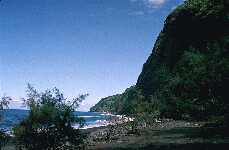
[photo from hypertext guide to Hawaii by J. Bisignani]
Back to Top
Back to Values Main Page
Back To Psy 412 Home Page
References
Gardner, G.T. & Stern, P.C. (1996). Environmental Problems
and Human Behavior. Needham Heights, MA: Allyn & Bacon.
Henn, A. et al. (1997). Development and Economy. Psy 412 Web
Page. Retrieved November 19, 1997 from the World Wide Web: http://www.users.miamioh.edu/shermarc/p412
Kasindorf, M. (1997, November 7). "Hard Times in
Hawaii". USA Today, pp. A17-A18.
Robert, K.H. (1991). Educating a Nation: The Natural Step. The
Natural Step Web Page. Retrieved November 6, 1997 from the World Wide Web: http://www.emis.com/tns/documents/articles/robert.htm
Back to Top
Back to Values Main Page
Back To Psy 412 Home Page
Psy 412 Miami
University. Last revised: . This document has been accessed times since July 15,
1997. Comments & Questions to R. Sherman .
Also See: Social Psychology at
Miami University