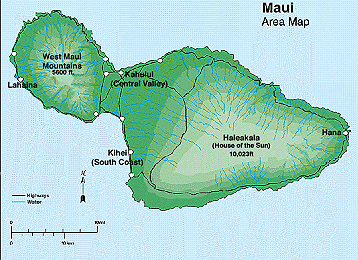
[Map used with permission of Maui Weather Today]
El Niño in Hawaii:Community
Management
Wendi Hauck, Ehren Hines, Denise Sobieski
& John Ward
Please Note: These materials may be used for research, study, and education, but please credit the authors and source.
Because of El Niño and Maui's constant water problem, strategies such as recycling water and minimally restricting population growth should be employed, and better water-saving devices should be used (Fletcher and Sharpe, 1980). Other things that should be considered are a water budget system recording water sources and uses, such as was used in Lahaina's water budget in 1996 (Shade, 1996). All of these can be implemented through incentives and education, as stated before,or they could be employed using community management. According to Elinor Ostrom, community management is a self-organized system of management created and operated by the users of the resources (Gardner and Stern, 1996). Management of resources works well with this approach if the resource has the following characteristics: It is a resource with boundaries such that its users are obvious, and it is a resource that will have detrimental effects on its users if it is depleted. Water in Maui has both of these characteristics. Its users are all of the people on Maui, and it if it is depleted, everyone will be affected.
[Map used with permission of Maui Weather Today]
Community management also depends on certain characteristics of the community. The community must be small and stable, with limited population growth. Maui has a relatively small population; however, it is growing. A way to handle this is to separate the population into smaller, more manageable parts, called "nested" institutions, that employ rules themselves. The stability factor is important because geographically tight social groups have shared norms and values within their networks of social interaction, making rules easier to enforce because of social pressure (Gardner and Stern, 1996). This is mainly how community management is runCby internalization. Internalization of certain social norms, such as water conservation, coerces people into following the rules because of an aversion to violating those norms and being outcast from society.
When community management is employed, there are guidelines for what rules should be enforced. The people in the community should be involved in making the rules. This makes them feel that the rules are fair, and they will be more likely to follow them. Also, the rules must "fit" the resource and be flexible to a change in conditions. In addition, the rules should build incentives. This will increase compliance. Lastly, the rules should have the ability to be easily and inexpensively monitored (Gardner and Stern, 1996).
If all of these stipulations are followed, then community management should work. It will work for Maui if nested institutions are employed. These smaller communities should elect a committee that makes up rules for conservation techniques and rationing. These rules can be voted on by the committee and possibly other community members. This will promote a feeling of equity and personal involvement. And, as stated before, the rules will be adhered to if they are internalized into the social norms of the community. Being a part of developing the rules enables this. Then the local government or police force can help enforce the rules, using incentives and punishments, such as fines. Community management is a definite solution to Maui's water problem. If it is administered properly, it can a have a powerful influence with positive and long lasting effects.
Next Page--Conclusions & References
Back to El Niño Table of
Contents
Back to El Niño Opening Page
Back To Psy 412 Home Page
Psy 412 Miami University. Last revised: . This document has been accessed times since July 15, 1997. Comments & Questions to R. Sherman . Also See: Social Psychology at Miami University