
Living in
a Social World
Psy 324: Advanced Social Psychology
Guidelines for World Wide Web Tutorial Projects
The tutorial project is a
major component of our course activities. It is intended to give you the opportunity to
use your knowledge of social psychology, your skills in acquiring new information, and
your ability to communicate with others in creating something that will have lasting
impact. Your tutorial will be published on the World Wide Web and will remain there for at
least four years, available to future students at Miami and around the world.
The overall goal of the tutorial is to inform and educate a visitor to
the website about a specific topic in Social Psychology. You should assume the visitor is
intelligent but not necessarily familiar with the field of psychology -- a reasonable
model might be a student in the Introductory Social Psychology class.
The topic for the tutorial
should be an important and interesting aspect of the field. Avoid topics that are too
broad (e.g., "prejudice" or "group processes") or too narrow (e.g.,
"prejudice toward people from eastern Latvia" or "group interaction in
advanced psychology courses"). Some examples of topics that might be appropriate are:
You may use any of these ideas or come up with another. Even if you do use one of those listed, selecting a topic should involve some careful thought and research by your team. Sources of information and of ideas might include Intro Social Psychology textbooks, our own textbook, and your own experience and that of your teammates.
Your topic must be
submitted in writing by 5 p.m. February 11th and approved before you can proceed. Note that duplication of topics
with another team is not permitted. We will follow the FIGIT procedure in case two or more teams have the same idea ("First in Gets IT"). Each team should email me a 1-page
summary description of their topic and subtopics (see below) no later than 5 p.m. Friday, February 11th. These
descriptions, when approved, will be posted on our website, and we will discuss them in
class.
[Note: At this time we are attempting to make arrangements with Psy 221 Instructors to allow a small-scale evaluation of your tutorial near the end of this semester. If this is the case, your evaluation instrument may have to be prepared and available earlier than presently indicated.]
The overall structure of the tutorial might be pictured as follows:
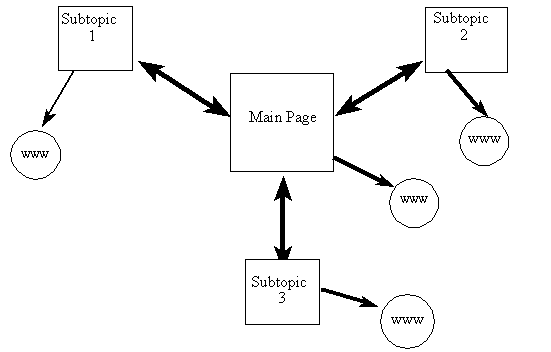
The tutorial should make effective and
interesting use of hypertext and involve active decision making that leads to significant
consequences (for example, to receiving feedback or providing opportunity to delve more
deeply into a subtopic). We will discuss the pedogogical principles of incorporating
hypertext into the web tutorial structure at various points in the course.
The best examples of existing tutorials that use the above structure are those constructed by students in earlier offerings of this course. Their work should be regarded as a starting point, not as blueprint to be followed exactly. Examine the earlier tutorials carefully, then strive to improve on them.
Back to Top
Back To Psy 324 Home Page