
Group Decision Making and Environmentalists:
by Mick Rakauskas, Scott Constable,
"You too can be
mad like us!... Direct action releases our collective power. We are all
strong. Together we can create a new future" -
We have all been in situations where we felt that we were not acting as we normally do. Most of these situations are likely to be brought out by the extreme pressures of living and having to deal continuously with other people. Luckily for us there are groups we can turn to where the beliefs are clearly stated and there are no trick norms in fine print, right? Well, you might see it that way, or you might see the extreme passivity and single-mindedness of some social group participants as very disturbing. In either case, environmental groups are no different than any other when it comes to being a part of group decision making.
Groups are nothing more than a bunch of people who are working at the same goals, in the same place, at a given time. However, when people meet in this way, startling changes in the behavior of individuals emerge. As stated by Latanè (1981) in his Social Impact Theory, the total impact of other people in an individual depends on the number, strength, and immediacy of other observers. When observers have a higher level of power (determined by status, age, relationship), or are greater in number and proximity, there will be a greater effect on the individual's behavior. Latanè compares the phenomenon to a light falling on any surface. The amount of light that hits it depends on the number of bulbs, their wattage, and their closeness to the surface in question.
Many
environmental groups influence their members by creating an organization of many small
parts held together by a single set of beliefs. Earth First! (EF!), for example, is composed of
small, bioregionally-based groups who ask that prospective members start up factions in
their local areas. In that way, members are an intimate group, who want to maintain
personal group strength and who know that there are many more groups like
themselves. Even celebrities belong to
such groups, such as Woody Harrelson (seen here after participating in a "Save the
Headwaters" protest on the Golden Gate Bridge). Other splinter groups, such as
the Animal Liberation Front, are an
amorphous collection of radicals whose beliefs and Internet connections are the only
things that bind them together. Joining the ALF involves only coming up with your
own plan of ALF actions and implementing it.
belong to
such groups, such as Woody Harrelson (seen here after participating in a "Save the
Headwaters" protest on the Golden Gate Bridge). Other splinter groups, such as
the Animal Liberation Front, are an
amorphous collection of radicals whose beliefs and Internet connections are the only
things that bind them together. Joining the ALF involves only coming up with your
own plan of ALF actions and implementing it.
A strong sense of personal identity in a group sounds like it could lead to great results. In some cases however, personal identity is lost and replaced by an identification with the goals an actions of the group. This "deindividuation" is similar to the mob mentality described by Gustave LeBon (1896). He theorizes that in the right situations, the emotions of one person spread through the group like a cold through a schoolhouse. Control mechanisms such as values, ethics, and learned social rules are broken down and forgotten for the time. Forsyth (1990) sees the complete feeling of anonymity and being less accountable as the key to people actions. Many other theorists (Zimbardo, 1970; Diener, Fraser, Deamen, and Kelem, 1976) have done experiments showing that when the sense of responsibility for our actions is lost, the participants will behave in more drastic means then when they can be identified from other members.
Environmental
rallies and protests often end with some participants 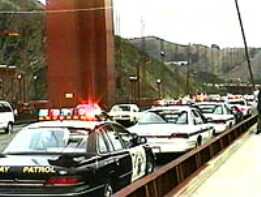 being arrested or doing things they would not normally have done.
Groups like Earth First! even promote and encourage their members to get involved in ways
that could very likely get them in trouble with local authorities.
This putting oneself in jeopardy for a cause shows that many average people would put
their normal standards aside or below the ideals and beliefs of the group.
being arrested or doing things they would not normally have done.
Groups like Earth First! even promote and encourage their members to get involved in ways
that could very likely get them in trouble with local authorities.
This putting oneself in jeopardy for a cause shows that many average people would put
their normal standards aside or below the ideals and beliefs of the group.
Deindividuation can be further seen
when Earth First! strongly promotes 'Family Outings' to help other EF! groups. This
terminology reminds one of a mother feeding common ideals to every small grouping of
activists.
Agreeing with the beliefs of a group not only hurts personal decisions, but those of the new collective consciousness. One form of this is known as "group polarization" and is characterized by a "risky shift" in decision making. What happens is that groups make decisions that are often riskier than the views held by individual members before the decision. Just think of all the factors that affect a single decision that is to be made. Persuasive arguments, for instance, can be used by the minorities of any group and still be influential. Also, people have a tendency to compare themselves socially to the opinions of others in the group. If the group tends to be leaning to a more radical idea, many others will also shift their in that direction.
In the skiing
community of Vail, Colorado on October 18, 1998, a similar decision was made by supposed
ecoterrorists. Vail Resorts, Inc. was about to start the clearing of a category III
ski area expansion, 2200 acres of back country which included 700 acres of old growth
forest and was a habitat for the endangered Canadian lynx. After much litigation, activists lit ablaze $12
million in damages to the ski lifts, ski patrol headquarters, and the elk lodge.
Incidentally, this seriously changed the mind set of locals against ELF/ALF (Environmental
/ Animal Liberation Fronts) 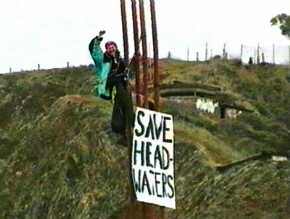 groups.
People who are now in these organizations probably started off small in their
revolutionary thinking. As they were surrounded by people like themselves, some had
more extreme ideas than others. With the sharing of these thoughts, the ideas of the
group as a whole grew farther and farther from the small original ideas to the mass
destruction that occurred (Markels 1999).
groups.
People who are now in these organizations probably started off small in their
revolutionary thinking. As they were surrounded by people like themselves, some had
more extreme ideas than others. With the sharing of these thoughts, the ideas of the
group as a whole grew farther and farther from the small original ideas to the mass
destruction that occurred (Markels 1999).
Even seemingly reasonable and intelligent groups of people make decisions that, in retrospect, were obviously going to be disasters. "Groupthink" of this nature is often seen if the group feels invulnerable, is highly cohesive, is isolated from outside influences, and has strong, dynamic leaders. To prevent groupthink and enhance the effectiveness of group decision making, the leader may encourage member to air objections, or he or she may also remain impartial to ideas as they are presented. The group may divide into subcommittees to check and balance itself or outside experts may be used to remind the group of consequences of their actions. Lastly, a devil's advocate can be very effective in challenging group ideas.
Some well
known examples of this "groupthink" phenomenon include the Challenger disaster
in 1986, Pearl Harbor, the Bay of Pigs invasion, the escalation of the Vietnam War, and
even the above Vail example may be included. Many groups who believe that
environmentalists are on the wrong
track point to the groupthink phenomenon. Even their stated philosophy seems to
reflect an overlooking of individual values. They state: "EF! believes in
using all the tools in the toolbox. EF!ers quite often have to break the law to
achieve their ends, but this is not a drawback - it's fun!" - Earth First!
[photos on this page used by permission of Headwaters Forest Earth First]
This tutorial was produced for Psy 324, Advanced Social Psychology, Spring 1999 at Miami University. All graphics are from the public domain, used with permission or under fair use guidelines, or were created by the authors. Social Psychology / Miami University (Ohio USA). Last revised: . This document has been accessed times since 1 May 1999. Comments & Questions to R. Sherman