A.I. Now & In The Future
A.I. in the 90's
A.I. use in many ways is not apparent at first
glance. Microsoft's homepage uses A.I. for
the help system that allows you to go directly to the things the user needs. Julia, an unsophisticated bot compared to
the 90's, was created using A.I. to pass the Turing Test to show computer
intelligence. (Julia will hold conversations with individuals). Artificial
intelligence is used to help pilots fly planes. Robotics incorporating
artificial intelligence interaction with laser, ultrasound, MRI scanning, are performing
delicate brain surgery more accurately than by traditional surgical
approaches. A.I. was used in the investigation of Mars in July
1997. The artificially intelligent, Sojourner, was programmed to leave
the Pathfinder to explore on its own. Another important use of A.I. is in Hazardous Duty Robots. Robots
are used in areas of 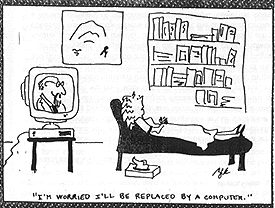 dangerous chemicals or
radioactivity. The possibilities of artificial intelligence are endless.
In all of these examples, it is key to note that the position of A.I. is one of creating a
safer more easily used and understood environment.
dangerous chemicals or
radioactivity. The possibilities of artificial intelligence are endless.
In all of these examples, it is key to note that the position of A.I. is one of creating a
safer more easily used and understood environment.
The Future of A.I.
Artificial intelligence in the 90's is centered around improving conditions for
humans. But is that the only goal in the future? Research is focusing on
building human-like robots. This is because scientists are interested in human
intelligence and are fascinated by trying to copy it. If A.I. machines can be
capable of doing tasks originally done by humans, then the role of humans will change.
Robots have already begun to replace factory workers. They are acting as
surgeons, pilots, astronauts, etc. According to Crevier, a computer scientist,
robots will take over clerical workers, the middle managers and on up. Eventually
what society will be left with are machines working at every store and humans on every
beach. As Moravec puts it, we'll all be living as millionaires.
The visions of some of these scientists seem like unrealistic utopian views. Other
scientists and theorists envision a more negative takeover. "The thinking power
of silicon 'brains' will be so formidable that 'if we are lucky, they will keep us as
pets'"(Postman). But what if these visions
become a reality? Will humans have to worry about
their futures if artificial intelligence takes over?
Back to Top
Back to Psybersite
This document was created April 19, 1998 and last modified on .
This document has been accessed times.
Please send comments and suggestions to shermarc@miamioh.edu