
Educational oppression of Blacks in the United States began with slavery. Slaves were mostly illiterate, and their education was forbidden in many places. In many southern states, ignorance laws were implemented with the basic idea of keeping slaves uneducated completely. Free Blacks had more, but still very limited, educational opportunities in the late 18th and 19th centuries. In terms of higher education, Lincoln University in Pennsylvania and Wilberforce University in Ohio admitted a few blacks, but Oberlin College was the first to admit large numbers of Blacks. The Civil War brought a halt to all education in the US, and afterwards, a policy of separation was implemented. The schools for Blacks were of infinitely poorer quality than the schools for Whites. The idea was that Black children did not need anything more than extremely basic skills.
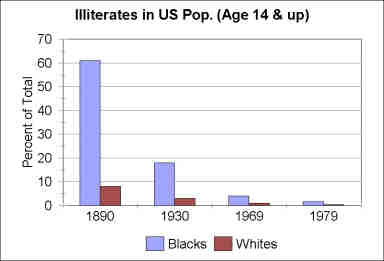
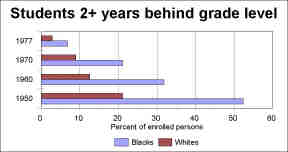
The first steps to the improvement of education for Blacks and the desegregation of the school system were the reforms implemented in the 1950s beginning with the court case of Brown v. Board of Education of Topeka. Thurgood Marshall argued in front of the Supreme Court that Black parents in several states had had their rights violated by the basic segregation in education law, due to the fact that the law in itself keeps them from having equal educational opportunities. Although Marshall won his case, the ruling for equality in schools was ignored by public schools until the 1960s. The second major landmark in eliminating racism and discrimination was the Civil Rights Act of 1964, which required the elimination of segregation in schools, colleges and created a commission to outlaw job discrimination based on sex, race, color, religion or national origin. The act had the effect of some integration, but other educators took it as an opportunity to close down Black schools and fire teachers in the name of equality. The isolation and struggles by Black students to gain and maintain a decent education in the 50s, 60s and 70s is demonstrated by their levels of inferior education in comparison to the higher level that is expected of a typical student.
Change has been slow in coming. Although there have been changes in law and policy, students still experience racism today in learning environments. The forms that racism take now, however, are more subtle and not the obvious shouted taunts and separate schools of years gone by. A study reported in The College Student Journal, "The Changing Nature of Racism On College Campuses: Study of Discrimination at a Northeastern Public University", indicated many minority students still feel the sting of prejudice, although it is less obvious now. The study began by choosing a sample from three minority groups (Black, Asian and Hispanic) proportionally from the percentage that those groups represent in the campus minority community. A survey was given that included structured and open ended questions and data was collected from the completed surveys. The results seemed to indicate that although racism is less obvious, it is still very present on college campuses. The very interesting part of the data is that the longer minority students are on campus, the more likely they are to experience some sort of racially motivated attack (verbal, physical, etc.). Of incoming freshmen, fourteen percent were victimized, twenty eight percent of those who had finished one but not more than four semesters experienced an incident and forty one percent of minority students who had attended at least five semesters were victimized.
[racist speech] [a brief history] [mother miami] [the victims] [front page] [references]