Social Issues and Psychology:
Psychology & The Environment
Fall, 1997
Overdevelopment of North Beach:
Morals and Values
Amy Henn, Cory King, Jeff Lewis & Marianna Panova
Please Note: These materials may be used for research, study, and education, but
please credit the authors and source.
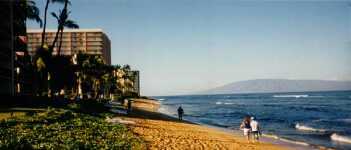 The situation
confronting Maui's North Beach is one that can be looked at in the context of the morals
and beliefs of both the Hawaiian citizens and the developers in the area. From this
perspective we will be able to determine the importance of both groups, helping us to find
a solution to the problems of North Beach. Central to this analysis are the ideas
surrounding the developers need to regain economic strength in Hawaii, as well as the
local citizens wish to preserve the ecological resources on the island of Maui. In looking
at several different environmental paradigms, we shall uncover the roots of the beliefs of
the two groups. [photo used by permission of SSEnterprises].
The situation
confronting Maui's North Beach is one that can be looked at in the context of the morals
and beliefs of both the Hawaiian citizens and the developers in the area. From this
perspective we will be able to determine the importance of both groups, helping us to find
a solution to the problems of North Beach. Central to this analysis are the ideas
surrounding the developers need to regain economic strength in Hawaii, as well as the
local citizens wish to preserve the ecological resources on the island of Maui. In looking
at several different environmental paradigms, we shall uncover the roots of the beliefs of
the two groups. [photo used by permission of SSEnterprises].
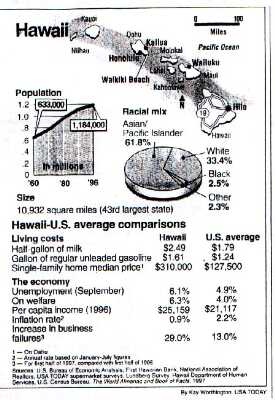 Amfac/JMB, the
corporation who wishes to extend its development on North Beach, views this development as
a way to remedy the states declining economy. The main argument that has been posed by
many on the island is that the resorts and hotels are old and outdated, causing people to
venture elsewhere in their quest for "paradise". The corporation sees the
development of a new resort as an attractive addition to the island of Maui, as well as an
economic resource on which to build for the future. In looking at the beliefs and values
presented here by Amfac, it is clear to assume that the Dominant Western Paradigm of
thought is motivating the push to develop. Within this paradigm, the most prevalent belief
is that of mans "dominance over nature." (Gardner and Stern, 1996) Such
homocentric values are only strengthened by Amfac/JMB Inc. desire to build another resort
in an area that has approximately fifteen existing facilities.
Underneath the idea of dominance over nature lies the notion that the earth and its
resources are mainly for human use. Once again we see how the build up of resorts in the
area continues to deplete the land as a resource for other living organisms in nature. In
looking at the Dominant Western Paradigm, it is clear that most important to the
corporation are the ideas of "economic growth for the human population" and
"consumerism"(Gardner and Stern, 1996). The problems in Hawaii's
economy have been documented earlier, and it seems to be the case that Amfac feels
this to be a viable solution. Yet, with the research presented, it has been suggested that
the citizens of Hawaii try to diversify the economy instead of concentrating only on the
tourism industry. The idea here seems to be that of the more that is offered, the more
people will come, which we have seen before and is not effective. The values and beliefs
presented by Amfac/JMB suggest those ideals central to a homocentric approach to the
environment. This states that the land and all that is in it, is primarily for the use of
humans. This can be seen in many areas of the corporations desire to build on North Beach.
[graph from USA Today]
Amfac/JMB, the
corporation who wishes to extend its development on North Beach, views this development as
a way to remedy the states declining economy. The main argument that has been posed by
many on the island is that the resorts and hotels are old and outdated, causing people to
venture elsewhere in their quest for "paradise". The corporation sees the
development of a new resort as an attractive addition to the island of Maui, as well as an
economic resource on which to build for the future. In looking at the beliefs and values
presented here by Amfac, it is clear to assume that the Dominant Western Paradigm of
thought is motivating the push to develop. Within this paradigm, the most prevalent belief
is that of mans "dominance over nature." (Gardner and Stern, 1996) Such
homocentric values are only strengthened by Amfac/JMB Inc. desire to build another resort
in an area that has approximately fifteen existing facilities.
Underneath the idea of dominance over nature lies the notion that the earth and its
resources are mainly for human use. Once again we see how the build up of resorts in the
area continues to deplete the land as a resource for other living organisms in nature. In
looking at the Dominant Western Paradigm, it is clear that most important to the
corporation are the ideas of "economic growth for the human population" and
"consumerism"(Gardner and Stern, 1996). The problems in Hawaii's
economy have been documented earlier, and it seems to be the case that Amfac feels
this to be a viable solution. Yet, with the research presented, it has been suggested that
the citizens of Hawaii try to diversify the economy instead of concentrating only on the
tourism industry. The idea here seems to be that of the more that is offered, the more
people will come, which we have seen before and is not effective. The values and beliefs
presented by Amfac/JMB suggest those ideals central to a homocentric approach to the
environment. This states that the land and all that is in it, is primarily for the use of
humans. This can be seen in many areas of the corporations desire to build on North Beach.
[graph from USA Today]
When we look at the Hawaiian citizens we see a very
different set of values and beliefs presented concerning the environment and the
development of North Beach. It is difficult to see where the citizens values lie when we
consider the fact that one out of three jobs on the island comes from the tourism industry
(USA Today, 1997). However, with respect to North Beach, we see a very different approach
than that held by Amfac/JMB. It is apparent that within the Hawaiian
community the Deep Ecology movement plays a major role in the preservation of land in
Hawaii and more specifically, Maui. Within this Deep 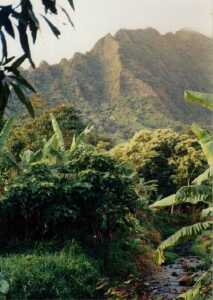 Ecology paradigm
there is the overlying notion that humans should live in "harmony with nature"
(Gardner and Stern, 1996). This ideology suggests that humans are not the only organisms
granted the use of land and resources, hence they should not abuse the little undeveloped
land they have left. In doing this, they present an ecocentric approach to the
environment. Taking a closer look at the ideas central to this movement we see the ideas
of "all nature having intrinsic worth" and "minority
tradition/bioregionalism" are both very important aspects with reference to the
citizens of Hawaii (Gardner and Stern, 1996). When we look at "intrinsic worth"
the main point being discussed is that of value being placed on the environment aside from
what it offers humans. This becomes a very important part of the struggle between the two
groups when we look at the proposal from Amfac to decrease the size of the resort in order
to facilitate the construction of a park on North Beach.
The question still remains though, what about everything else on North Beach? This
proposal gives more evidence for the homocentric stance Amfac has with reference to North
Beach, suggesting that offering something that preserves land for human use will rectify
the situation. If the citizens of Maui are truly exhibiting the behavior associated with
the Deep Ecology Movement, this us not an acceptable solution. [photo used by
permission of SSEnterprises]
Ecology paradigm
there is the overlying notion that humans should live in "harmony with nature"
(Gardner and Stern, 1996). This ideology suggests that humans are not the only organisms
granted the use of land and resources, hence they should not abuse the little undeveloped
land they have left. In doing this, they present an ecocentric approach to the
environment. Taking a closer look at the ideas central to this movement we see the ideas
of "all nature having intrinsic worth" and "minority
tradition/bioregionalism" are both very important aspects with reference to the
citizens of Hawaii (Gardner and Stern, 1996). When we look at "intrinsic worth"
the main point being discussed is that of value being placed on the environment aside from
what it offers humans. This becomes a very important part of the struggle between the two
groups when we look at the proposal from Amfac to decrease the size of the resort in order
to facilitate the construction of a park on North Beach.
The question still remains though, what about everything else on North Beach? This
proposal gives more evidence for the homocentric stance Amfac has with reference to North
Beach, suggesting that offering something that preserves land for human use will rectify
the situation. If the citizens of Maui are truly exhibiting the behavior associated with
the Deep Ecology Movement, this us not an acceptable solution. [photo used by
permission of SSEnterprises]
The contrast in values and beliefs between the two groups
only brings with it only more hostility towards the economic decline of recent years. In
order for a change to be made and the problems to be solved, a medium must be met between
these two groups.
Community Management
Incentives
Back to Top
Back to North Beach Opening Page
Back To Psy 412 Home Page
Here is a complete list of our references.
Psy 412 Miami
University. Last revised: . This document has been accessed times since July 15,
1997. Comments & Questions to R. Sherman .
Also See: Social Psychology at
Miami University