
[photo used by permission of SSEnterprises]
Overdevelopment of North Beach:
A Psychological Analysis
Amy Henn, Cory King, Jeff Lewis &
Marianna Panova
Please Note: These materials may be used for research, study, and education, but
please credit the authors and source.
[photo used by permission of SSEnterprises]
"Ruin is the destination toward which all men rush, each pursuing his own best interest in a society that believes in the freedom of the commons. Freedom in a commons brings ruin to all"
Robert M. Chute, Environmental Insight
The Tragedy of the Commons process plays a major role in causing most, if not all, of the environmental problems the world now faces (Gardner & Stern, 1996). These problems range from the polluting of a small stream to the exponential population growth that threatens the very existence of our species. This process occurs when there is unrestricted access to a natural resource, whether renewable or nonrenewable. However, it is important to note that only when human numbers are at extremely high levels will this unrestricted access to common pool resources trigger the Tragedy of the Commons. For these reasons, we believe that the island of Maui is experiencing a Tragedy of the Commons process of its own.
 Both tourists
and citizens have had more or less unrestricted access to one of the island's most
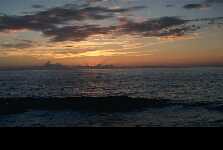
important natural resources - the beaches. [photo used by permission of SSEnterprises]
These long stretches of white sand, once home to a variety of wildlife and open to
the public for the enjoyment of its scenic views, have been bombarded with the rapid
development of hotels
and luxury resorts. This overdevelopment has been in response to Maui's booming
tourist industry. Tourism has become Maui's #1 industry, surpassing both agriculture and
cattle ranching. Although this is positive for the island's economy, it has many negative
implications for the environment. The island's beauty and many attractions has lured
hundreds of thousands of tourists each year. The population has exploded
from 43,100 to 110,313, doubling in a mere 35 years. This influx of people has placed
tremendous pressure on the island's environment and has encouraged more and more
development, promoting tourism. As a result, wilderness areas, public access, and other
conservation efforts have been diminished. This assertion seems to be in contrast to a
report published in USA Today (1997). The article suggests that one reason for Hawaii's
troubled economy lies in the vast amounts of red tape designed to slow the rapid growth of
the 1980's. The article claims that this red tape could delay a new hotel project for
years. However, we see a very different picture. The beaches continue to be developed upon
at a rapid rate as evidenced by Amfac's current development plan of Maui's North Beach.
For all the above reasons, we believe that tourists and citizens alike are trapped in the
Tragedy of the Commons. The overdevelopment of Maui's beaches is self-serving in nature.
Maui's economy depends on it. Maui's government wants to ensure the maximum good for every
person. But the question Robert Chute poses, as well as ourselves, is "what is
'good"'? Chute (197l) asserts that "To one person it is wilderness, to another
it is ski lodges for thousands".
Both tourists
and citizens have had more or less unrestricted access to one of the island's most
important natural resources - the beaches. [photo used by permission of SSEnterprises]
These long stretches of white sand, once home to a variety of wildlife and open to
the public for the enjoyment of its scenic views, have been bombarded with the rapid
development of hotels
and luxury resorts. This overdevelopment has been in response to Maui's booming
tourist industry. Tourism has become Maui's #1 industry, surpassing both agriculture and
cattle ranching. Although this is positive for the island's economy, it has many negative
implications for the environment. The island's beauty and many attractions has lured
hundreds of thousands of tourists each year. The population has exploded
from 43,100 to 110,313, doubling in a mere 35 years. This influx of people has placed
tremendous pressure on the island's environment and has encouraged more and more
development, promoting tourism. As a result, wilderness areas, public access, and other
conservation efforts have been diminished. This assertion seems to be in contrast to a
report published in USA Today (1997). The article suggests that one reason for Hawaii's
troubled economy lies in the vast amounts of red tape designed to slow the rapid growth of
the 1980's. The article claims that this red tape could delay a new hotel project for
years. However, we see a very different picture. The beaches continue to be developed upon
at a rapid rate as evidenced by Amfac's current development plan of Maui's North Beach.
For all the above reasons, we believe that tourists and citizens alike are trapped in the
Tragedy of the Commons. The overdevelopment of Maui's beaches is self-serving in nature.
Maui's economy depends on it. Maui's government wants to ensure the maximum good for every
person. But the question Robert Chute poses, as well as ourselves, is "what is
'good"'? Chute (197l) asserts that "To one person it is wilderness, to another
it is ski lodges for thousands".
 There
are several issues we feel should be explored to better analyze the overdevelopment of
Maui's beaches and its relation to the Tragedy of the Commons. Incentives play a key role in the development of the island.
It is well known that people make choices in regard to their immediate, personal
consequences. Tourism is extremely important to Maui's economy. It is a $11 billion-a-year
industry that provides one out of every three jobs (USA Today, 1997). Without further
development, hundreds of thousands would suffer economic consequences. To avoid this, many
support the construction of additional tourist facilities. We will take a closer look at
the current incentives that are driving further development and offer suggestions for
incentives that may curtail this problem. [photo from hypertext guide to
Hawaii by J. Bisignani]
There
are several issues we feel should be explored to better analyze the overdevelopment of
Maui's beaches and its relation to the Tragedy of the Commons. Incentives play a key role in the development of the island.
It is well known that people make choices in regard to their immediate, personal
consequences. Tourism is extremely important to Maui's economy. It is a $11 billion-a-year
industry that provides one out of every three jobs (USA Today, 1997). Without further
development, hundreds of thousands would suffer economic consequences. To avoid this, many
support the construction of additional tourist facilities. We will take a closer look at
the current incentives that are driving further development and offer suggestions for
incentives that may curtail this problem. [photo from hypertext guide to
Hawaii by J. Bisignani]
To further analyze the situation, we believe that the morals and values of both developers/ tourists and Native Hawaiians must be examined. We frame this discussion on morals and values in terms of the Dominant Western Paradigm, which is human centered and appears to represent those morals and values of the developers and other business personnel and the Deep Ecology Paradigm, which is nature centered and appears to represent Native Hawaiians and any others who argue for the protection of the environment.
And finally, we explore Gardner & Stern's (1996) assertion that the Tragedy of the Commons process cannot be stopped by unilateral individual action and the implications this has for community management. We believe that this may be an effective strategy to halt overdevelopment, replenish wildlife reserves, and allow tourists and citizens alike to experience the "true" beauty of Maui.
Incentives
Morals and Values
Community Management
Back to Top
Back To Psy 412 Home Page
Here is a complete list of our references.
Psy 412 Miami University. Last revised: . This document has been accessed times since July 15, 1997. Comments & Questions to R. Sherman . Also See: Social Psychology at Miami University