
Living in a Social World
Psy 324: Advanced Social Psychology
Spring, 1998
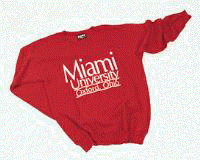 Why is it that the day after a "big win" everyone pulls out
their old sweatshirts and tee shirts, that haven’t been worn since the team last won
a game two years ago, and proudly displays their school colors or team logos? Or right
after a team wins a championship the sales of their products sky rocket until another team
wins the next year? This phenomena has been labeled by social psychologists as BIRGing and
CORFing. BIRGing is an arconym for Basking in Reflected Glory and CORFing means Cutting
Off Reflected Failure. One of the most influential studies of this phenomena was done by
Cialdini et al. in 1976. et al. It provided the support for BIRGing by conducting a study
that showed how undergraduate students at six different universities were more likely to
wear their university affiliated apparel the Monday morning after a victorious football
weekend. They also found that the college students were more likely to use the pronoun
"we" after a successful athletic
weekend than if their team had lost. The students sought to have the success of the team
linked to themselves by wearing school identifying clothing.
Why is it that the day after a "big win" everyone pulls out
their old sweatshirts and tee shirts, that haven’t been worn since the team last won
a game two years ago, and proudly displays their school colors or team logos? Or right
after a team wins a championship the sales of their products sky rocket until another team
wins the next year? This phenomena has been labeled by social psychologists as BIRGing and
CORFing. BIRGing is an arconym for Basking in Reflected Glory and CORFing means Cutting
Off Reflected Failure. One of the most influential studies of this phenomena was done by
Cialdini et al. in 1976. et al. It provided the support for BIRGing by conducting a study
that showed how undergraduate students at six different universities were more likely to
wear their university affiliated apparel the Monday morning after a victorious football
weekend. They also found that the college students were more likely to use the pronoun
"we" after a successful athletic
weekend than if their team had lost. The students sought to have the success of the team
linked to themselves by wearing school identifying clothing.
The concept of BIRGing is rooted in the social
identity theory which explains how one’s self esteem and evaluation can be enhanced
by the identification with another person’s success. One of the keys to BIRGing is
that the person trying to receive this glory has done nothing tangible to bring the
team’s success (Hirt et al. 1992). They are truly basking in reflected glory not earned.
When a person’s public image is threatened the tendency to BIRG is even stronger, and
BIRGing becomes an important impression management technique to counter any threats to
self esteem (Lee 1985).
self esteem and evaluation can be enhanced
by the identification with another person’s success. One of the keys to BIRGing is
that the person trying to receive this glory has done nothing tangible to bring the
team’s success (Hirt et al. 1992). They are truly basking in reflected glory not earned.
When a person’s public image is threatened the tendency to BIRG is even stronger, and
BIRGing becomes an important impression management technique to counter any threats to
self esteem (Lee 1985).
The different levels of commitment that a fan might have towards a
team dictate the degree to which he or she can distance him or herself from that team when
failure occurs.  If a fan is strongly allied, the social identity theory states that
it will be hard for them to distance themselves, and therefore, to not threaten their self
esteem, the fans must attribute the loss to external cues of the situation but not the team itself. If a person
is not so closely linked they then engage in the phenomena of CORFing, which means cutting
off reflected failure, done by distancing themselves as far as possible from the losing
team. (Cialdini & Richardson 1980). These fans want to avoid any negative evaluations
by others in relation to the team that was unsuccessful. The closer the identification to
the team and the degree of commitment by the fan, the greater the risk the fan has of
suffering a loss in self esteem if their team has lost.
If a fan is strongly allied, the social identity theory states that
it will be hard for them to distance themselves, and therefore, to not threaten their self
esteem, the fans must attribute the loss to external cues of the situation but not the team itself. If a person
is not so closely linked they then engage in the phenomena of CORFing, which means cutting
off reflected failure, done by distancing themselves as far as possible from the losing
team. (Cialdini & Richardson 1980). These fans want to avoid any negative evaluations
by others in relation to the team that was unsuccessful. The closer the identification to
the team and the degree of commitment by the fan, the greater the risk the fan has of
suffering a loss in self esteem if their team has lost.
Fans CORF in a variety of different ways. For example one might
change the language they use to describe the game after a defeat or after a win. For
example a Knicks basketball fan might not even know the psychological defenses he or she
is using when they say, "We won" when the Knicks won and "They lost"
or "the Knicks lost" when the team suffered a defeat. Fans might also distance
themselves from the team by not wearing any team affiliated clothing after a loss and not
supporting the team until  they win again. But as soon as the team is victorious, the
individual will waste no time in associating with the team once again (Hirt et al. 1992).
they win again. But as soon as the team is victorious, the
individual will waste no time in associating with the team once again (Hirt et al. 1992).
Another way that fans can CORF is by "blasting". Blasting is a form of indirect self enhancement used when when self esteem is threatened. Cialdini and Richardson (1980) found and illustrated this phenomena by how university undergraduates blasted (criticized and degraded) the other universities when they received negative information about their own school. "Therefore if we wish to look good to observers, one option available to us would be to make those with whom we are negatively connected with look bad: to publicly blast the opposition"(Cialdini et al. 1980).
Back to Top| Learn More About: | |||
| Ingroup/Outgroup Bias | Social Identity Theory | BIRGing and CORFing | Deindividuation |
| References | |||
Back
To Psy 324 Home Page
Back to Psybersite
Please note: Original materials in these pages can be used for
research and education, but please credit the authors and the source. All
copyrighted materials are used here with permission and may not be reused without
contacting the copyright holder.