
Living in a Social World
Psy 324: Advanced Social Psychology
Spring, 1998
Why
Your Favorite Team is "Your" Favorite Team?: The Psychology of Sports Fans
Sascha Hansen, Michael Perry
Merritt Posten & Jamie Schlabach
Introduction
by
Sascha Hansen
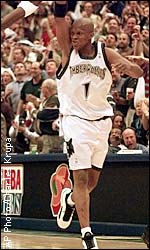 Like it or not,
sports have become a part of our everyday lives. For some it is a job, a hobby, or a form
of entertainment. For others sports are an obsession or an annoyance. Even if people are
not watching actual sporting events, they are still subjected to sports in other ways
including movies, for example: The Fan, Space Jam, Rudy, and Major League. In any case
there are people who do enjoy sports which is where our focus lies. According to
Webster’s dictionary (1976) those who are "an enthusiastic devotee of a sport or
diversion, usually as a spectator rather than a participant" are called fans as
opposed to those who "exhibit excessive enthusiasm and intense uncritical
devotion" are called fanatics. Perhaps there is a difference between a sports fan and a
fanatic but the explanations for their behavior are similar.
Like it or not,
sports have become a part of our everyday lives. For some it is a job, a hobby, or a form
of entertainment. For others sports are an obsession or an annoyance. Even if people are
not watching actual sporting events, they are still subjected to sports in other ways
including movies, for example: The Fan, Space Jam, Rudy, and Major League. In any case
there are people who do enjoy sports which is where our focus lies. According to
Webster’s dictionary (1976) those who are "an enthusiastic devotee of a sport or
diversion, usually as a spectator rather than a participant" are called fans as
opposed to those who "exhibit excessive enthusiasm and intense uncritical
devotion" are called fanatics. Perhaps there is a difference between a sports fan and a
fanatic but the explanations for their behavior are similar.
Within the category of fans or fanatics are several other
groups, including those who are fans of one team opposed to those who are fans of another team.
Explained by in-group, out-group bias people will categorize
themselves as part of the in-group, the group that they belong to, and all others are a
part of the out-group. Often times in-group/out-group biases will occur, where the
in-group deems themselves superior to the out-group (Devine, 1996). This may also lead to
intergroup bias which is where people of the in-group see their differences as good if it
is beneficial to their group and negative when present in the out-group.
are fans of one team opposed to those who are fans of another team.
Explained by in-group, out-group bias people will categorize
themselves as part of the in-group, the group that they belong to, and all others are a
part of the out-group. Often times in-group/out-group biases will occur, where the
in-group deems themselves superior to the out-group (Devine, 1996). This may also lead to
intergroup bias which is where people of the in-group see their differences as good if it
is beneficial to their group and negative when present in the out-group.
Another explanation for the behavior of fans is found when looking
at the social  identity
theory, where a person is motivated to behave in ways that will boost their
self-esteem (Tesser, 1995). Sports fans feel that they can maintain or boost their
self-esteem by identifying with a sports team. Ways of identifying with a team is
demonstrated by fans through BIRGing and CORFing or Basking In
Reflective Glory and Cutting Off Reflective Failures respectively.
identity
theory, where a person is motivated to behave in ways that will boost their
self-esteem (Tesser, 1995). Sports fans feel that they can maintain or boost their
self-esteem by identifying with a sports team. Ways of identifying with a team is
demonstrated by fans through BIRGing and CORFing or Basking In
Reflective Glory and Cutting Off Reflective Failures respectively.
Finally fans also demonstrate a process called deindividuation where people lose their self-awareness and have decreased concern for how others around them evaluate their actions (Mann, et al., 1982). In this way people seem to lose or change part of their identity and take on a whole new identity when engrossed in sports. Often times people are swept up in the moment of a sporting event and lose their individuality and act as a group. For example one group of fans may strike out against the opposing team’s fans and a riot may break out.
There are other aspects of sports that may effect the behavior of fans that are not specifically addressed here, but some of them include aggression, gender equity, culture, and hormones. Exploring these theories and those above may provide further explanation for why individuals act the way they do at a sporting event or even when watching sports on television.
| Learn More About: | |||
| Ingroup/Outgroup Bias | Social Identity Theory | BIRGing and CORFing | Deindividuation |
| References | |||
Back to Top
Back To Psy 324 Home Page
Back to Psybersite
Please note: Original materials in these pages can be used for
research and education, but please credit the authors and the source. All
copyrighted materials are used here with permission and may not be reused without
contacting the copyright holder.