
Living in a Social World
Psy 324: Advanced Social Psychology
Spring, 1998
 for adaptive functioning. Social
categorization reduces the complexity of the social world. We use this idea to put people
into categories like Miami University students or Proctor and Gamble employees. A very
prominent category that many people belong to is that of a sports fan. Whether a Green Bay Packers fan, a
Chicago Bulls fan, or a Miami Redhawk fan, a person fits into a category depending on who
they cheer for. Categorizing people into groups by identifying some common attributes or
characteristics reduces the amount of information to be dealt with (Hamilton, 1981) Such
categorization can represent a sensible and useful strategy to reduce the complexity of
the social world. But there are also some consequences that go along with this
simplification strategy.
for adaptive functioning. Social
categorization reduces the complexity of the social world. We use this idea to put people
into categories like Miami University students or Proctor and Gamble employees. A very
prominent category that many people belong to is that of a sports fan. Whether a Green Bay Packers fan, a
Chicago Bulls fan, or a Miami Redhawk fan, a person fits into a category depending on who
they cheer for. Categorizing people into groups by identifying some common attributes or
characteristics reduces the amount of information to be dealt with (Hamilton, 1981) Such
categorization can represent a sensible and useful strategy to reduce the complexity of
the social world. But there are also some consequences that go along with this
simplification strategy.
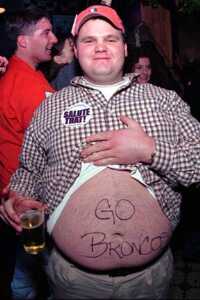 When a person identifies themselves with a group, they perceive themselves
and the group members as different from other groups. A Packers
fan may work with a Broncos fan, where
both of them hold the same position, both love pizza, and both live in the same community.
But the Packers fan will view the Bronco fan as being significantly different from
himself. If another coworker is also a Packers fan, but lived on the other side of town
and hated pizza, he would still be viewed as more similar to the Packers fan then the
Broncos fan. A partial explanation for such in-group favoritism is provided by the social identity theory. Categorization can also create a basis for
ethnocentrism, or the belief that one’s own group is superior to other groups. People
will put themselves into the "in-group" and all other people are in the
"out-group." This leads in-group members to favor their group over the out-group
and is called in-group, out-group
bias (Devine, 1996). Sports fans of any kind favor their teams fans over the other
team’s fans. The fans of the opposing team are not seen as friends or equals, they
are the enemy. During a game, fans of each team do not socialize with the opposing fans.
The seating arrangement during games is usually segregated, with, for example, the Packers
fans on one side of the stadium and Broncos fans on the other. This separation contributes
to favoritism of the in-group over the out-group.
When a person identifies themselves with a group, they perceive themselves
and the group members as different from other groups. A Packers
fan may work with a Broncos fan, where
both of them hold the same position, both love pizza, and both live in the same community.
But the Packers fan will view the Bronco fan as being significantly different from
himself. If another coworker is also a Packers fan, but lived on the other side of town
and hated pizza, he would still be viewed as more similar to the Packers fan then the
Broncos fan. A partial explanation for such in-group favoritism is provided by the social identity theory. Categorization can also create a basis for
ethnocentrism, or the belief that one’s own group is superior to other groups. People
will put themselves into the "in-group" and all other people are in the
"out-group." This leads in-group members to favor their group over the out-group
and is called in-group, out-group
bias (Devine, 1996). Sports fans of any kind favor their teams fans over the other
team’s fans. The fans of the opposing team are not seen as friends or equals, they
are the enemy. During a game, fans of each team do not socialize with the opposing fans.
The seating arrangement during games is usually segregated, with, for example, the Packers
fans on one side of the stadium and Broncos fans on the other. This separation contributes
to favoritism of the in-group over the out-group.
Intergroup bias is the belief that one’s own group is better than all other groups. Even when categorization is arbitrary and unrelated to psychological characteristics, intergroup bias is still established. The mere categorization of people into groups can lead to increased attraction of in-group members and devaluation of out-group members. This is called the minimal group paradigm and was pioneered by Henri Taifel. In a study done by Howard and Rothbart (1980), subjects were randomly assigned to one of two different groups in which they did not know anyone. They were then presented with a mix of positive and negative information about their group, the in-group, and the other group, the out-group. Subjects had more favorable expectations about in-group members and more negative expectations about out-group members, even though they did not know the members of either group personally. This demonstrates the minimal group paradigm, which shows why something as meaningless as being a sports fan can lead to such discrimination against fans of opposing teams. In-group members tend to behave in more prosocial ways and be more cooperative toward other in-group members than to out-group members. Sports fans obviously are more prosocial and cooperative toward the in-group members then the out-group. Rarely will fights occur between two Packers fans, but it is common to see fights between Packers and Bronco fans.
Recent studies have shown that even the
language used to refer to in-group and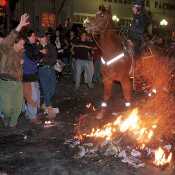 out-group status helps create intergroup
bias. By using pronouns such as "we" or "they" and "us" and
"them," in-group, out-group bias can be emphasized. Packers fans who say
"We are going to win today, and they are going to loose" are viewing themselves
as part of the team and demonstrating intergroup bias. The mere categorization of people
into groups leads people to the processing of information about in-groups and out-groups
in ways that cause intergroup differences to appear legitimate and justified (Hamilton
& Trolier, 1986). A Packers fan sees all of the other members of his in-group as being
similar only in positive traits. Differences between them are accentuated when they are
favorable to the in-group, but are minimized if they are favorable to the out-group
(Brewer & Kramer, 1985). This leads to a more positive opinion of the in-group over
the out-group. Sports fans of all kinds will continue to see their in-group as being
superior over the out-group, whether they know the members personally or not.
out-group status helps create intergroup
bias. By using pronouns such as "we" or "they" and "us" and
"them," in-group, out-group bias can be emphasized. Packers fans who say
"We are going to win today, and they are going to loose" are viewing themselves
as part of the team and demonstrating intergroup bias. The mere categorization of people
into groups leads people to the processing of information about in-groups and out-groups
in ways that cause intergroup differences to appear legitimate and justified (Hamilton
& Trolier, 1986). A Packers fan sees all of the other members of his in-group as being
similar only in positive traits. Differences between them are accentuated when they are
favorable to the in-group, but are minimized if they are favorable to the out-group
(Brewer & Kramer, 1985). This leads to a more positive opinion of the in-group over
the out-group. Sports fans of all kinds will continue to see their in-group as being
superior over the out-group, whether they know the members personally or not.
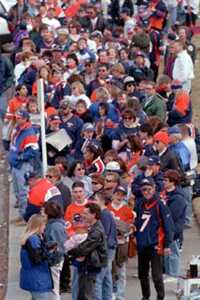 The out-group
homogeneity effect suggests that out-group members are not only seen as being
different from the in-group, but also seen as being more interchangeable with each other.
They are perceived as being more similar in their characteristics, opinions, and behaviors
then in-group members. Packers fans look at Broncos fans and think "they are all
alike." This effect can be caused by many things. It could be because of minimal
contact with out-group members or the nature of the contact with these members. When fans
of the Packers and Broncos come together for the purpose of cheering their team to
victory, group members are likely to display a uniform set of behaviors relevant to the
specific context. If it is only that set of circumstances where the Packers fans have
contact with Broncos fans, it is unlikely that much diversity of out-group members will be
appreciated. Memory processes may also contribute to the out-group homogeneity effect. An
in-group member can think of specific representatives from their group, but they think
more abstractly of out-groups (Judd & Park, 1988). Because of a failure to retrieve
specific examples of a Broncos fan, Packers fans perceive Broncos fans as being
homogeneous to each other.
The out-group
homogeneity effect suggests that out-group members are not only seen as being
different from the in-group, but also seen as being more interchangeable with each other.
They are perceived as being more similar in their characteristics, opinions, and behaviors
then in-group members. Packers fans look at Broncos fans and think "they are all
alike." This effect can be caused by many things. It could be because of minimal
contact with out-group members or the nature of the contact with these members. When fans
of the Packers and Broncos come together for the purpose of cheering their team to
victory, group members are likely to display a uniform set of behaviors relevant to the
specific context. If it is only that set of circumstances where the Packers fans have
contact with Broncos fans, it is unlikely that much diversity of out-group members will be
appreciated. Memory processes may also contribute to the out-group homogeneity effect. An
in-group member can think of specific representatives from their group, but they think
more abstractly of out-groups (Judd & Park, 1988). Because of a failure to retrieve
specific examples of a Broncos fan, Packers fans perceive Broncos fans as being
homogeneous to each other.
Back to Top
Back to Intro Page
| Learn More About: | |||
| Ingroup/Outgroup Bias | Social Identity Theory | BIRGing and CORFing | Deindividuation |
| References | |||
Back
To Psy 324 Home Page
Back to Psybersite
Please note: Original materials in these pages can be used for
research and education, but please credit the authors and the source. All
copyrighted materials are used here with permission and may not be reused without
contacting the copyright holder.