
Living in a Social World
Psy 324: Advanced Social Psychology
Spring, 1998
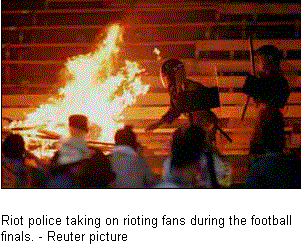 What causes crowds to act the way they do? Why do fans throw garbage onto the playing
field or scream until they lose their voices? According to the social identity theory,
fans tend to identify themselves as part of the team they are watching; they feel
intimately involved in the action. Another contributing influence is deindividuation, a
state characterized by a loss of self-awareness, a sense of diffused responsibility, and
decreased concern about how others may evaluate one’s behavior (Mann, et al., 1982).
This results in the abandonment of normal restraints and inhibitions, without which, fans
demonstrate increased responsivity to situational forces; they may throw
garbage, boo and jeer players or referees, or even riot.
What causes crowds to act the way they do? Why do fans throw garbage onto the playing
field or scream until they lose their voices? According to the social identity theory,
fans tend to identify themselves as part of the team they are watching; they feel
intimately involved in the action. Another contributing influence is deindividuation, a
state characterized by a loss of self-awareness, a sense of diffused responsibility, and
decreased concern about how others may evaluate one’s behavior (Mann, et al., 1982).
This results in the abandonment of normal restraints and inhibitions, without which, fans
demonstrate increased responsivity to situational forces; they may throw
garbage, boo and jeer players or referees, or even riot.
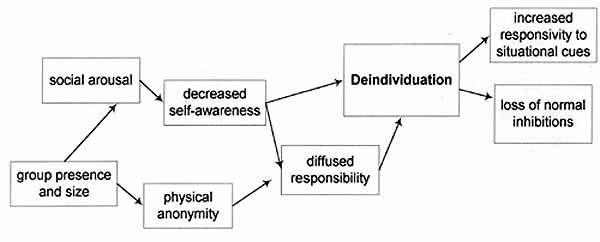
This figure shows how a number of factors interact to cause deindividuation. Several influences converge to create a sense of diffused responsibility, which decreases the burden of accountability that an individual would normally assume for his or her actions (Myers, 1996). Simply being in the presence of other people can cause one’s personal sense of responsibility to diminish, demonstrated by the fact that people are less likely to help someone when other people are nearby (Darley & Latane, 1968). When others are nearby, people are more likely to wait for someone else to assume responsibility and act.
Groups, in addition to contributing to the diffusion of
responsibility, provide a measure of physical anonymity to their members. The actions of a
given individual cannot be determined, and thus cannot be judged or evaluated. Specific
individuals really cannot be criticized when the crowd they are in begins to shout
obscenities, because no one knows whether or not that individual actually participated. A
large group provides people with anonymity, which decreases a single person’s
accountability, in turn decreasing his or her sense of responsibility. 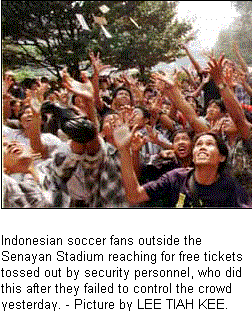
Mann (1981) examined crowds that were present when someone was threatening to jump off a tall building or tower. He found that more anonymous crowds, as measured by size, cover of darkness, and distance from the victim, were more likely to bait or jeer the person.
[photo courtesy of the The Straits Times]Deindividuation involves a loss of self-awareness (Diener, 1979), which is essentially the degree to which one’s attention is focused on the self, resulting in comparisons of oneself against meaningful standards (Tesser, 1995). When spectators’ become deindividuated, their self-awareness plummets and they cease comparing their behavior against these standards. They tend to act like everyone else. Without the comparison process of self-awareness, people’s behavior is more likely to be inconsistent with their attitudes. For example, at a hockey game, the fans cheer loudest when they see a player get slammed into the wall or when they witness a fight. But how many of those same fans truly wish to condone violent behavior?
The diffused responsibility and decreased self-awareness provide the wood and gasoline for deindividuation, but without the spark of social arousal, nothing happens (Diener, 1976). Sporting events are a particularly illustrative example of social arousal. Fans are watching, intensely involved in the game and already displaying a measure of arousal. They get even more aroused when something exciting happens, whether good or bad. Fans may scream and yell if their team wins the championship or they will scream and yell if the referee makes a bad call, and when they hear others doing likewise, they get even more aroused. Deindividuated behavior usually enters the picture at this point, when the crowd is no longer self-aware, but focused on the game, when the crowd is so large that they cannot possibly be held personally responsible for their actions, and when everyone gets suddenly hyper-aroused. This is usually when fans get unruly; they throw things, fights break out, they riot.
These people show increased responsivity to social and situational forces, tending to conform to the group they are with. Prentice-Dunn and Rogers (1980) demonstrated that deindividuated people tend to display aggression when others around them are behaving violently. If everyone else in the crowd is distracting the goalie or the batter by shouting obscene remarks or chanting, a given individual, when deindividuated, is likely to join in. It is difficult to imagine a single person or a scattered handful of people spontaneously throwing objects onto a baseball field during a game. It usually does not happen like that. People get involved in the game, they see a call they disagree with, then they see other people throwing objects onto the field, so they do the same.
Not only are people more responsive to situational influences, but
they are also disinhibited (Spivey & Prentice-Dunn, 1990). The normal  constraints
on behavior, long-term norms, self-monitoring, and self-awareness, to mention a few, are
no longer present, so people tend to act on the basis of immediate emotions and
motivations, without considerations that might otherwise prevent the behavior (Diener,
1980). Lacking ordinary inhibitions, fans tear up their seats, they throw things, they
start fires, they rush the field. People are trampled, burned, beaten, and killed.
constraints
on behavior, long-term norms, self-monitoring, and self-awareness, to mention a few, are
no longer present, so people tend to act on the basis of immediate emotions and
motivations, without considerations that might otherwise prevent the behavior (Diener,
1980). Lacking ordinary inhibitions, fans tear up their seats, they throw things, they
start fires, they rush the field. People are trampled, burned, beaten, and killed.
So what can we do? How can we prevent fans from getting unruly and people from getting hurt? Some nations have extremely tight security, but this has inherent problems. The solution lies in stopping the process of deindividuation, rather than punishing the results. The best way to do that is to try to encourage people to be self-aware at sporting events. This has been done in experimental settings with mirrors and video cameras; by forcing an individual to see himself, you force him to think about himself and that is self-awareness. In stadiums and ballparks, mirrors could be placed on many of the walls. When people see themselves, their self-awareness will increase and their deindividuation will decrease. Additionally, it is important to stop unruly behavior early, because it further arouses, and thus further deindividuates, more people who may be nearby. The group may then start drawing more members, so the crowd must be stopped as early as possible. Alcohol consumption is another variable that can increase deindividuated behavior in a number of ways. First, alcohol can increase social arousal. Second, Hall et al. (1983) have demonstrated that alcohol reduces self-awareness. Both of these promote deindividuation. Finally, alcohol further reduces inhibitions, so that the combination of deindividuation and intoxication is dangerous and has been deadly in the past. For this reason some nations have prohibitions on the sale or consumption of alcohol during sporting events.
Back to Top
Back to Intro Page
| Learn More About: | |||
| Ingroup/Outgroup Bias | Social Identity Theory | BIRGing and CORFing | Deindividuation |
| References | |||
Back
To Psy 324 Home Page
Back to Psybersite
Please note: Original materials in these pages can be used for
research and education, but please credit the authors and the source. All
copyrighted materials are used here with permission and may not be reused without
contacting the copyright holder.